
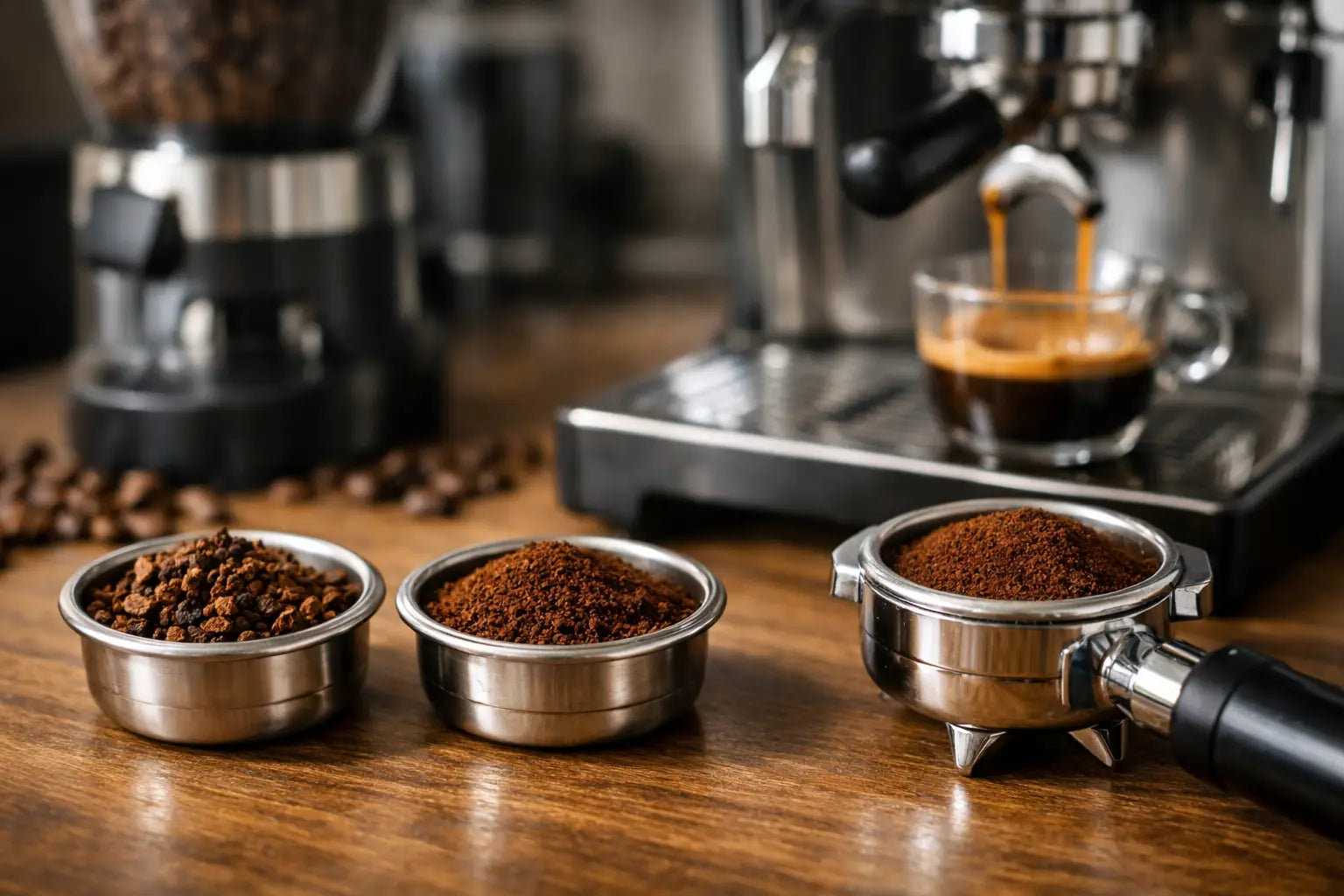
An espresso that runs through in 12 seconds and tastes sour, or a shot that barely comes out of your machine and ends bitter — the problem is often not your machine, but your grind. So the question of which grind size is right for espresso does not have one setting or one number as its answer. You are not looking for a fixed setting; you are looking for the right resistance for your beans, machine and recipe.
What is the right grind size for espresso?
For espresso, your grind is almost always on the fine side. Finer than filter coffee, coarser than powder. In practice, however, that only helps to a limited extent, because the perfect grind depends on what happens in your cup. Espresso is an extraction under pressure. The water has to draw enough flavour from the coffee in a short time. If the grind is too coarse, the water runs through too quickly and you get a weak, often sour espresso. If the grind is too fine, the puck becomes blocked, the shot takes too long and bitterness and dryness become more noticeable.
The right grind size is therefore the one that lets your shot run within a sensible time window while tasting sweet, full and balanced. As a starting point, think of around 25 to 30 seconds for a classic espresso, measured from the moment the pump starts. If you use a recipe of 18 grams in and 36 grams out, you are often already in a useful zone from which to fine-tune.
Why there is no universal answer
When people search online for the right espresso grind size, they usually hope for a simple answer. Setting 4. Or setting 7. Espresso is simply not that cooperative. The right setting varies by grinder, bean and even by the moment you brew.
Fresh specialty coffee behaves differently from old supermarket beans. A light roast often needs a different setting from a darker roast. Humidity, temperature and the age of your beans after roasting also play a part. Extremely fresh beans may run differently from beans that have rested for ten days.
That is why making espresso is not a matter of getting it right once and never touching the grinder again. You adjust. Sometimes a little finer, sometimes a little coarser. That is not a nuisance; it is simply how good espresso works.
Start with a logical espresso recipe
Before you change the grind size, make the rest of the process stable first. Use a fixed dose of coffee, weigh the output in the cup and keep an eye on the time. Without those three points, you are guessing.
A reliable starting point at home is 18 grams of ground coffee in your portafilter and 36 grams of espresso in the cup. Aim for 25 to 30 seconds. Is your shot far outside that range? Then adjust the grind. Does your shot run through in 18 seconds? Grind finer. Is there still too little in the cup after 35 seconds? Grind coarser.
These small corrections make a big difference. With espresso, a tiny turn of your grinder is often enough. Large jumps usually only create confusion.
What you can taste
Your tongue often tells you what is wrong faster than a stopwatch.
If your espresso tastes sour, thin or watery, the extraction is often too low. This is usually because the grind is too coarse, although a brewing temperature that is too low or a poorly distributed puck can also play a part. In practice, grinding finer is the first logical step.
If your espresso tastes bitter, harsh or dry, the extraction is often too high. Your grind is probably too fine, especially if the shot is also running slowly. Grinding coarser will usually give you more balance.
Sweetness is the signal that you are moving in the right direction. Not sugary sweet, but rounded, full and pleasant. Espresso may be intense, but it should never taste aggressive.
How freshness affects your grind size
For home baristas, this is an underestimated factor. Freshly roasted coffee is livelier and contains more gas. As a result, the same bean may behave differently during its first few days than it does a week later. Very fresh beans often need a slightly coarser or otherwise different setting from beans that have had more time to rest, depending on the roast and bean structure.
What matters most is working with fresh beans and storing them properly. Poorly stored coffee becomes flatter and less predictable. You can keep turning the grinder, but the foundation is already gone. Specialty coffee only truly shows what it can do when its freshness is right.
Store your beans airtight, away from light and heat, and grind them just before brewing. It sounds simple, but the difference in the cup is significant.
The role of your coffee grinder
If you cannot get your espresso stable, the grinder is surprisingly often the reason. For espresso, you need a grinder that can grind fine enough and make small adjustments. An entry-level grinder without precise adjustment makes it difficult to land exactly between too coarse and too fine.
You notice this especially when your shot runs too quickly on setting 5 and suddenly chokes on setting 4. The finesse espresso needs is missing. You can have excellent beans, but you do not have enough control.
A good espresso grinder produces more even particles, fewer extreme variations and more control over the extraction time. That gives you not only better-tasting shots, but also less frustration in the morning.
Stepless or stepped
A stepless grinder is useful because you can make very precise adjustments. But a stepped grinder can work perfectly well too, as long as the steps are small enough. At home, you do not need professional café-level equipment straight away. You do need to be able to make nuanced corrections.
If you use a machine with pressurised baskets, you have a little more room for error. With a traditional portafilter without that additional pressure build-up, the grind size matters much more. You notice every deviation immediately in the cup.
Common mistakes when grinding for espresso
The first mistake is changing too much too quickly. A shot runs a little fast, so you immediately turn the grinder three steps finer. Then it chokes, and you no longer know what the real cause was. Work calmly and change only one thing at a time.
The second mistake is not using scales. You can make espresso by feel, but not if you want to learn or repeat the result. Half a gram more or less in your basket can already have a significant effect on the extraction time.
The third mistake is trying to rescue old coffee with the grind size. You can correct a lot with grind, but not everything. Beans that have lost their freshness rarely produce the full, sweet espresso you are hoping for.
Distribution and tamping matter too. If your puck is distributed unevenly, water finds the easiest route. This creates channeling: one part of the coffee is over-extracted while another part is under-extracted. You taste this as an unsettled, messy espresso. Even so, grind size is usually your first and most important adjustment point.
A practical guide: finer or coarser?
Not sure what to do while dialling in? Keep this simple rule in mind. If your espresso runs too quickly and tastes sour or empty, grind finer. If it runs too slowly and tastes bitter or heavy, grind coarser. Then change nothing else and pull another shot.
Next, look not only at the time, but also at the flow. A good espresso often starts slowly, builds nicely and runs like warm honey. Not like water, but also not as separate drops throughout the entire shot.
That visual guide is especially helpful at home, where machines are sometimes less stable than those in an espresso bar. With a fixed recipe and fresh beans, you can still get surprisingly far.
What grind size for light or dark roast espresso?
The roast also makes a difference. Lightly roasted coffee is often denser and more difficult to extract. You will regularly need to grind a little finer to draw enough flavour from the bean. Darker roasted coffee extracts more easily and can become bitter more quickly, so you may sometimes end up a little coarser.
That does not mean light roast must always be ground extremely fine and dark roast must always be coarser. It remains a combination of bean, grinder and recipe. But if you switch coffees and your shot suddenly runs completely differently, the roast is a logical explanation.
Specialty espresso therefore always needs a little recalibration. That is part of the process. Once you accept that, you can get much more from good beans at home.
How to find your ideal point
Do not see grind size as a theoretical setting, but as a practical control. You start with a recipe, observe time and taste, and then adjust. Not blindly, but with a clear goal: more balance in the cup.
For most home users, this approach works best: choose one coffee, use a fixed dose, weigh your output, note the time and change only the grind. After a few shots, you will see a pattern. Espresso suddenly becomes much less mysterious.
Good coffee genuinely rewards that attention. With fresh beans, a decent grinder and small adjustments, you can get close to the espresso you hope to drink when you are out. Often even better, because you can adjust it precisely to your own taste.
So when you stand in front of your machine tomorrow and ask yourself which grind size you need for espresso, do not think in settings but in results. Your grinder is there to bring the coffee to the right point — and you ultimately taste that point in your cup.
Share:
How to Choose Coffee Beans for Working from Home
How to Buy Fresh Coffee Beans Online