
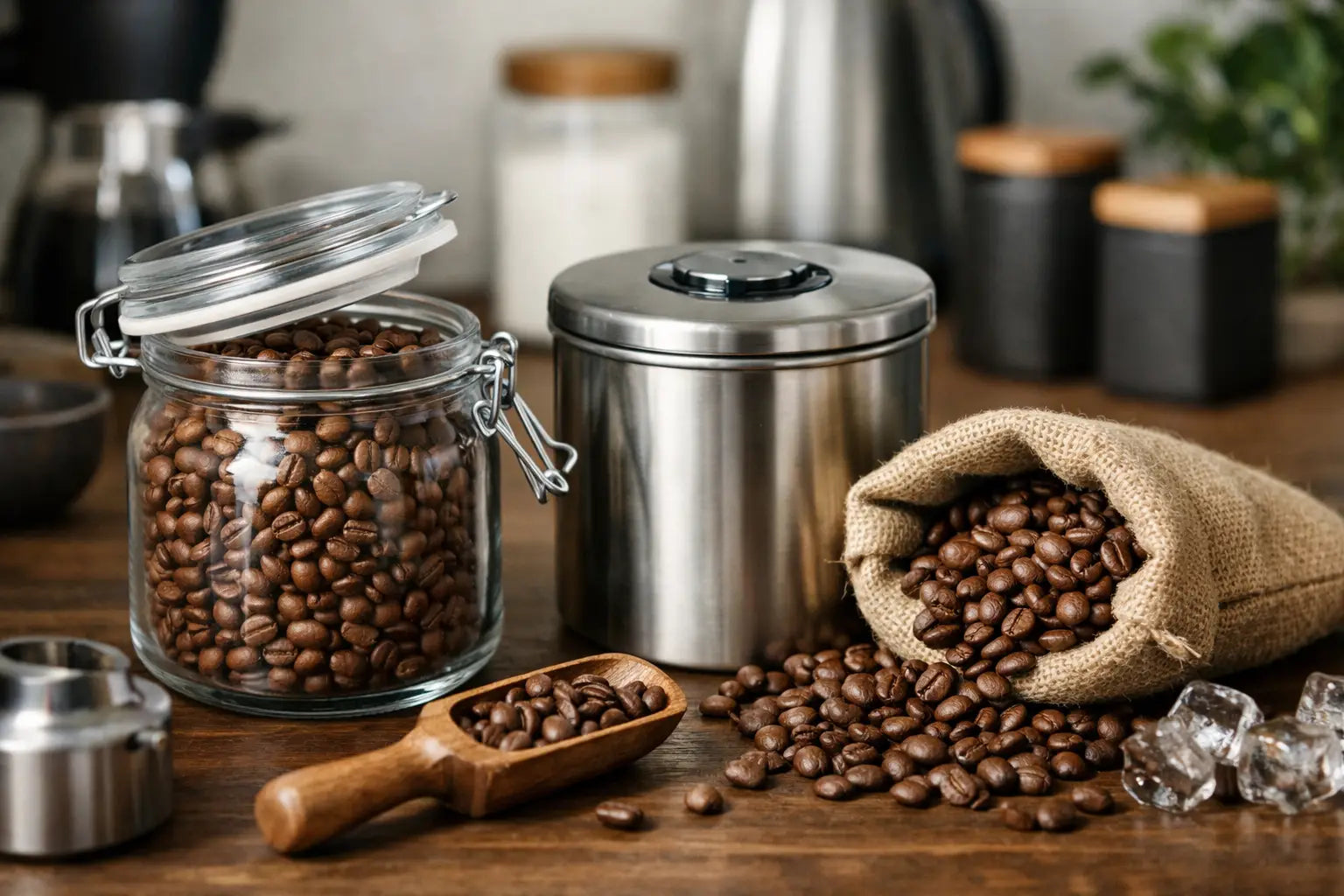
You buy seriously fresh coffee beans, brew a first excellent espresso or filter coffee at home, and three days later the same bag already tastes flatter. What a shame. If you are wondering how to store coffee beans properly, it does not have to be complicated—but it does have to be precise enough. Freshness is lost to four classic enemies: oxygen, light, moisture and heat.
You notice this especially quickly with specialty coffee. Good beans have more aromatic nuance, but are therefore less forgiving when left half-open on the worktop. Storage does not determine everything, but it determines surprisingly much.
How to store coffee beans without losing flavour
The short version is simple: store coffee beans airtight, in the dark, somewhere dry and cool. Not in direct sunlight, not next to the oven and preferably not in a folded-open bag with a clip on it. It sounds basic, but this is where things often go wrong in practice.
Oxygen is the biggest troublemaker. After roasting, coffee beans initially release CO2, but oxidation also starts to break down their aroma slowly. You cannot stop the process completely, but you can slow it down considerably. A good airtight storage canister helps much more than an ordinary kitchen cupboard by itself.
Light and heat speed up ageing. In a sunny kitchen, you notice it in the cup: less sweetness, less layering and more cardboard-like or dull notes. Moisture is a different problem. Beans absorb odours and moisture from their surroundings, which is the last thing you want when they are next to herbs, cleaning products or a boiling kettle.
The best place in your home for coffee beans
A dark kitchen cupboard is usually fine as long as it is not above a radiator, dishwasher or oven. The best place is boring—and that is exactly the point. Coffee stores best in a stable place where temperature and humidity do not keep changing.
The worktop is often less suitable than people think. It is convenient, but beans receive more light, heat and temperature swings there. Especially in modern kitchens with lots of glass or open-plan kitchens, this can have a greater effect than you expect.
If you have a small household and finish a 250-gram bag within two or three weeks, a good canister in a dark cupboard is usually enough. If you buy larger quantities because you like to stock up, portioning becomes more important.
In the original bag or in a storage canister?
That depends on the bag. A quality coffee bag with a valve and good seal already offers considerable protection. But many bags become less airtight after opening, especially when you repeatedly fold them open and push them back into the cupboard. Some of your coffee then loses freshness unnecessarily quickly.
A solid coffee bean storage canister is therefore not a gadget but practical equipment. A canister that actively limits or removes air does something a half-open bag cannot. For people who brew coffee every day and want to get the most from fresh beans, it is often the most logical upgrade after a good grinder.
Use a clean, dry canister and do not keep topping it up with new beans while old leftovers are still inside. That may seem efficient, but you are mixing different levels of freshness. It is better to empty it, clean it, let it dry properly and then refill it.
Transparent storage jars look nice but are less sensible
Glass jars on the worktop look cosy, especially when you are proud of your beans. Still, this is usually not the best choice. Transparent glass lets light through, and if the jar is also warm, you lose freshness twice as quickly. If you insist on keeping the beans visible, at least choose opaque material and a genuinely good seal.
Should coffee go in the fridge?
Short answer: no. The fridge sounds cool and therefore logical, but it is usually not a good place for coffee beans. There is moisture in the air, plenty of odours and, every time you take something out, a risk of condensation from temperature differences.
Coffee is porous and easily absorbs surrounding odours. Nobody wants beans that vaguely smell of leftover cheese or curry. Cool storage only helps when it is properly controlled, which is rarely the case in an ordinary fridge.
For everyday use, room temperature in a stable, dark place is simply better. Not spectacular, but effective.
What about the freezer?
The freezer is a different story. Not for your daily supply of beans, but useful when you buy larger amounts that you will not finish within a few weeks. Freezing can work well, provided you do it properly.
The key is portioning. Divide the beans into small, airtight portions that you will use all at once later. This prevents the same beans from coming out of the freezer and going back in repeatedly. Repeated thawing and refreezing is exactly what causes problems.
After freezing, let a portion come to temperature while still sealed before opening it. Otherwise, condensation forms on the beans. For enthusiastic home drinkers who buy kilo bags for price or convenience, this can be a smart way to preserve quality for longer. But for a bag you will finish quickly anyway, freezing is often unnecessary.
How long do coffee beans stay good?
Good is not the same as excellent. Technically, beans remain usable for a long time, but the flavour standard is higher with specialty coffee. Most beans are at their best in the first weeks after roasting once they have rested, depending on roast, bean, packaging and brewing method.
A slightly longer rest can be beneficial for espresso because freshly roasted beans still release a lot of gas. With filter coffee, you often want to retain lively aromas. The practical rule at home is simple: buy smaller quantities more often rather than one huge supply that slowly gets old.
If you really pay attention to flavour, you will often notice a difference two to four weeks after opening when storage has been poor. Good storage clearly extends that window. Not forever, but noticeably.
Whole beans stay good longer than ground coffee
This may be the most important practical choice of all. As soon as coffee is ground, the contact surface increases enormously and freshness declines much faster. If possible, buy whole beans and grind them just before brewing.
This gives you more aroma, but also more control over your grind. For anyone who puts effort into better coffee at home, this is essentially the standard approach.
Common mistakes when storing coffee beans
The biggest mistake is thinking that “roughly right” is good enough. Specialty coffee punishes carelessness more quickly than supermarket beans, precisely because there is more flavour to lose. An open bag on the worktop, a nice glass jar beside the window and storing beans in the fridge are all logical ideas that disappoint in the cup.
Another common mistake is ordering too much at once without a plan. Buying in bulk can be smart, but only if you know what you will drink soon and what you will freeze separately. Otherwise, you pay for freshly roasted coffee and drink half of it only after its best moment has passed.
One more small detail makes a difference: do not scoop beans from a canister with a wet spoon and do not leave the lid open unnecessarily long. These are small habits, but coffee freshness is the sum of them.
What works best in practice?
For most home coffee drinkers, the best approach is surprisingly straightforward. Buy whole beans in an amount you will finish within two to four weeks. Store them in an airtight, opaque canister in a dark, dry place. Grind just before use. If you do want to buy more, freeze part of it immediately in individual portions.
This is not an obsessive ritual, but simply a smart way to handle a product that tastes best when fresh. Especially when you deliberately choose specialty coffee, you want to taste what you are paying for. Storage is not an afterthought but a logical part of making good coffee at home.
At Eddy’s Coffee, a lot revolves around fresh roasting and fast delivery, but that freshness still needs to survive at home afterwards. A good bean deserves better than chance in the kitchen cupboard.
The best storage tip is ultimately not the most exciting one: treat coffee as if flavour were temporary. Because it is. Anyone who takes that into account gets more from the same bag every day.
Share:
How to Buy Decaf Coffee Beans Without Regret
How to Choose a Coffee Canister for Coffee Beans