
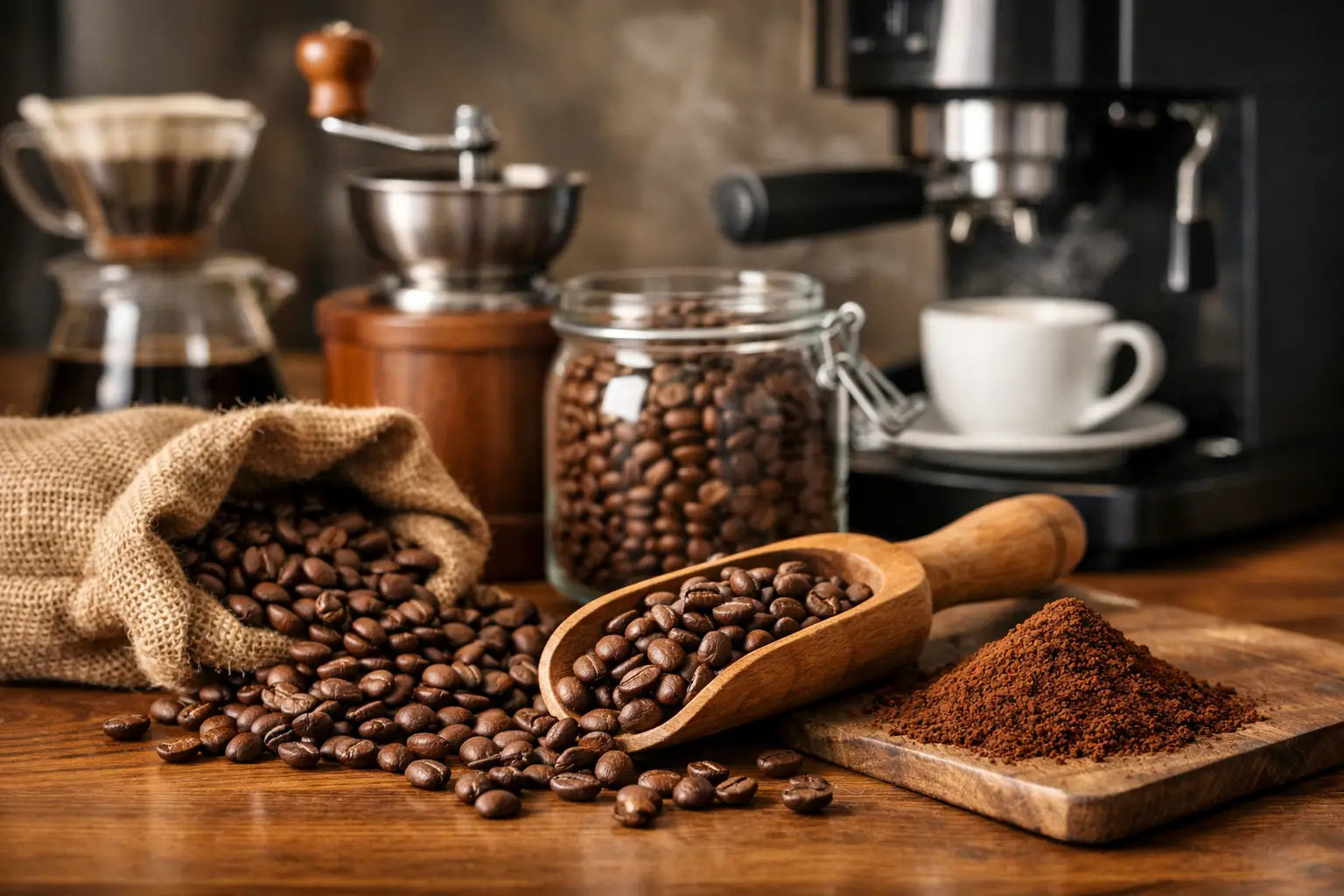
You often notice it as soon as the bag is opened. The aroma is fuller, livelier and exactly what you hope for from good coffee. That is the heart of why buying fresh coffee beans makes such a difference. Not because it is a fashionable detail, but because freshness directly affects flavour, aroma and how reliably your coffee works at home.
Many coffee drinkers invest in a good machine, a decent grinder and better water, but unknowingly continue using beans that were roasted weeks or months ago. That means leaving behind the area where the biggest gain is found. Fresh beans give you more nuance in the cup, more control while brewing and, above all, fewer Monday-morning disappointments.
Why buying fresh coffee beans really makes a difference
Coffee is not a product that remains at the same level for months after roasting. Once beans are roasted, something slowly starts to disappear. Aromas fade, liveliness decreases and flavours become flatter. What remains is still coffee, but no longer the coffee you paid for.
With fresh coffee, you usually taste more sweetness, more recognisable notes and a cleaner finish. Chocolate tastes genuinely chocolatey, fruit stays fresh instead of sour and nutty notes become rounded instead of dry. It may sound subtle, but in practice the difference is large enough that many people do not want to return to standard supermarket beans after one good fresh bag.
Fresh does not always mean drinking the coffee on the same day as quickly as possible. Coffee often needs a short rest after roasting to reach its potential. This is especially true for espresso, where beans are often more stable and balanced after a few days. The real gain is therefore not extreme speed, but buying beans roasted recently that are still within their best period.
Flavour loss starts sooner than many people think
A coffee bean looks solid and protected, but after roasting it is more vulnerable than it appears. Oxygen, light, heat and moisture all work against you. Oxygen is the biggest culprit. It affects the oils and aromatic compounds in the bean, causing flavours to become duller over time.
That is why the roast date is much more useful than a general best-before date. A best-before date mainly tells you whether a product is still expected to be usable. A roast date tells you something about quality. For anyone who wants to make genuinely good coffee at home, that is the difference between “fine” and “this is seriously good.”
With filter coffee, fresh beans often give you more clarity and detail. With espresso, you mainly notice a better body, more consistent crema and a flavour that is less likely to turn bitter or stale. Fresh beans are therefore not only tastier but also more practical. You need fewer corrections while brewing.
Why old beans often taste flat or bitter
As coffee gets older, it does not only lose aroma. The balance shifts too. What was once sweet and lively can become drier, woodier or papery. Some people unconsciously compensate by brewing hotter, grinding finer or using more coffee. But that does not solve the problem. You are trying to force freshness back into the coffee when it has simply gone.
This also explains why the same machine can make excellent coffee one week and disappoint you the next. It is not always your equipment. Often, the beans have simply passed their best.
Fresh beans give you more control while brewing
When you make coffee at home, you do not want to guess every morning. You want a bean that responds predictably and a recipe that does not suddenly fall apart. Fresh coffee beans help because they behave more consistently during grinding and extraction.
For espresso, that usually means a more even flow and a flavour that is easier to dial in. With filter coffee, you more often get a cleaner extraction without the cup becoming empty or thin. That is particularly useful if you want quality but do not want to spend twenty minutes tinkering every day.
There is some nuance, though. Beans that are extremely fresh, immediately after roasting, can still be unsettled. Espresso may run too quickly or erratically. Filter coffee is often more forgiving. Fresh coffee therefore works best when freshness is combined with good timing: not old, but also not blindly choosing the youngest roast date without considering the brewing method.
Freshness works slightly differently for espresso and filter
With filter coffee, you can often achieve a good result fairly soon after roasting, depending on the bean and roast. Espresso is more sensitive because built-up gases have more influence on extraction. That does not mean fresh espresso has to be difficult. It does mean that good roasters know when beans are ready to ship, rather than simply claiming that everything is “ultra-fresh.”
That distinction matters. Real freshness is not a marketing term, but a combination of good roasting, smart packaging and delivery at the right time.
Why buying fresh coffee beans is smarter than picking up supermarket beans
Supermarket beans win on convenience, but rarely on freshness. Often you do not know when they were roasted—only how long they can be sold or kept according to the package. That is still an option if you need something quickly, but it falls short when flavour and quality matter.
Recently roasted specialty coffee gives you a much better chance of a cup that really shows what is in the bean. You taste origin more clearly, roast is less likely to become a bitter smoke screen and even decaf can taste surprisingly lively when freshly roasted.
There is also a price difference. Fresh specialty beans are usually more expensive than mass-produced coffee. But you are not only paying for a more luxurious label. You are paying for better green coffee, more care in roasting and, above all, beans that still perform as intended. Anyone who drinks serious coffee at home notices the difference quickly enough for the price to make sense.
How to recognise genuinely fresh coffee beans
Buying fresh coffee beans starts with looking at information that actually matters. A roast date is the most important thing. Not vague language such as “always fresh” or “artisan”, but something concrete: when were these beans roasted?
Packaging matters too. A good bag protects against air and light and usually has a valve, allowing gases to escape from the bean without oxygen entering. Transparency about origin, roast and flavour profile also helps you choose more intelligently. It says something not only about quality, but also about how seriously a supplier treats coffee.
When ordering online, you also want clarity about delivery time. Freshly roasted is good, but it also needs to reach you quickly. For many home baristas and busy coffee drinkers, that is the added value of a reliable online shop. You do not have to choose between convenience and quality when the logistics are well organised.
After purchase, storage determines how much freshness you keep
If you invest in fresh beans and then leave them open on the worktop, you are throwing away quality unnecessarily. The best place for coffee is cool, dry and dark. Not the fridge, where condensation and odour transfer are more likely. Room temperature, well sealed, usually works best.
A reliable storage canister is especially useful if you regularly have an open bag. It is handy with larger orders too. It limits contact with oxygen and keeps the flavour stable for longer. Also grind just before brewing whenever possible. Whole beans stay good longer than ground coffee.
The same principle applies here: freshness is not an all-or-nothing story. An excellent bean stored well will remain enjoyable longer than an average bean that happened to be roasted yesterday. But when quality and freshness come together, you reach the point where coffee at home becomes genuinely enjoyable.
When freshness matters less
Not everyone notices every detail equally, and that is fine. If you mainly drink milk drinks with lots of sugar or syrup, some of the difference is masked. Superautomatic machines with limited settings also cannot always bring out everything that is in a bean.
Even then, you often notice a gain in aroma, softness and aftertaste. Fresh beans do not automatically make coffee more complicated or elitist. Quite the opposite. Good coffee becomes easier to understand when the flavours work together.
For many people, that is the real answer to why buying fresh coffee beans is worthwhile. Not to turn every cup into a tasting note, but to drink coffee at home that tastes consistently good without hassle. When you choose beans that are freshly roasted, arrive well packaged and are offered honestly, you get the foundations right immediately. You taste that not only in the first cup, but in every morning that follows.
Share:
Buy Freshly Roasted Coffee Beans
How to Buy Decaf Coffee Beans Without Regret