
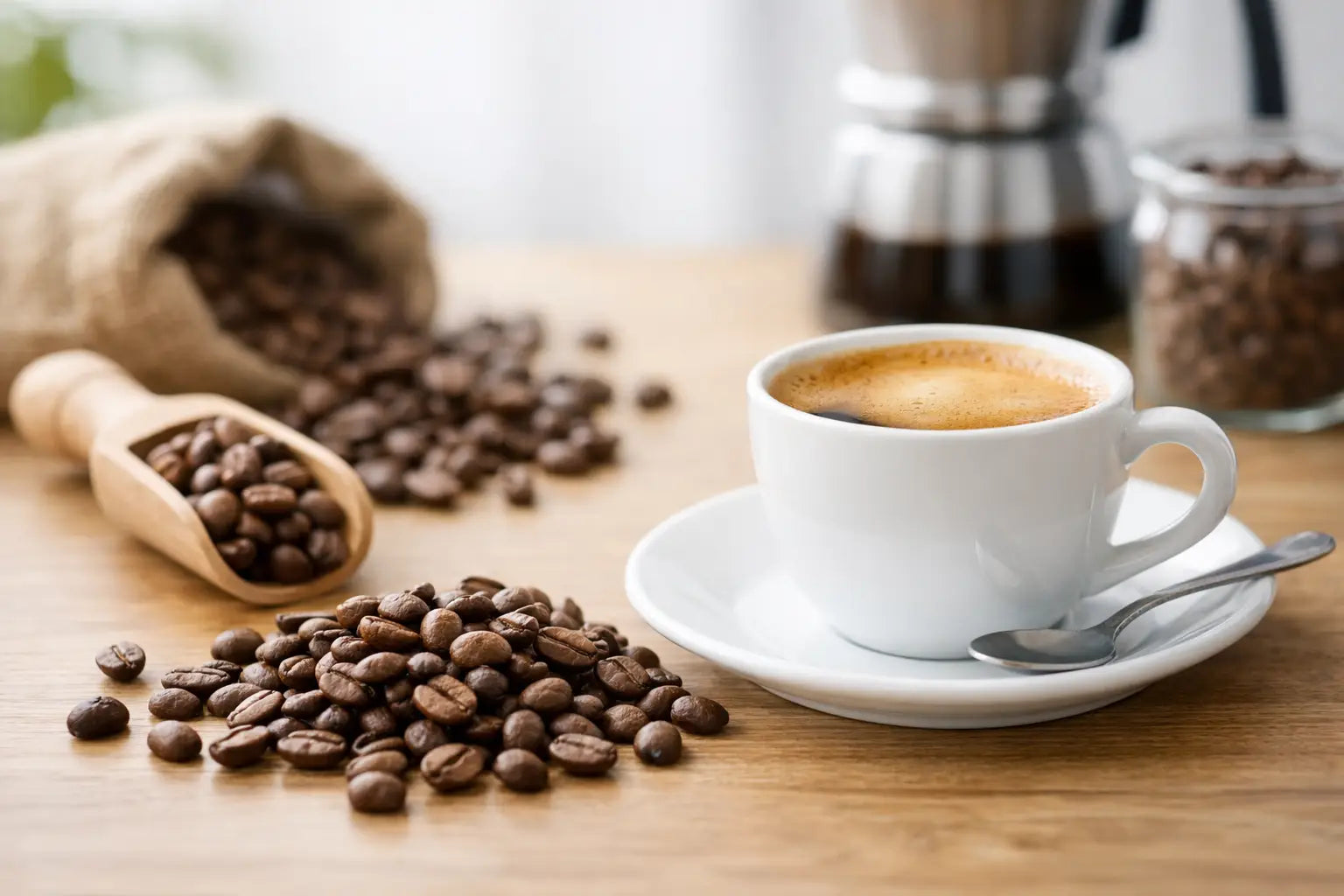
You notice it immediately when the dose is wrong. Too few beans and your coffee tastes flat, thin and a little sad. Too many and you get a heavy, bitter mug that is mainly expensive. So how many coffee beans you need per cup is not a minor detail, but the foundation of genuinely good coffee at home.
How many coffee beans per cup is a good starting point?
For most brewing methods, 7 to 9 grams of coffee works well for a cup of around 125 ml. If you prefer a larger 200 to 250 ml mug, you will usually need 12 to 18 grams. This is why the question creates confusion: a “cup” means a small coffee cup to one person and a large morning mug to another.
As a rule of thumb, use 60 grams of coffee per litre of water. This is a strong, reliable starting point for filter coffee, pour-over, French press and many automatic machines. Adjust to taste. If the coffee is too light, increase the dose. If it is too intense or bitter, use a little less coffee or adjust the grind.
For whole beans, the practical weight is almost the same as for ground coffee: 1 gram of beans remains approximately 1 gram after grinding. The difference is not the weight, but how fresh the coffee remains until grinding. That is where you gain a great deal of flavour at home.
It depends on your brewing method
Not every machine needs the same dose. Treating every method identically rarely gives the best result.
Espresso
For a single espresso, 7 to 10 grams is common. A double espresso usually uses 16 to 20 grams. Espresso is concentrated, so the amount per cup seems relatively high. That is normal. An espresso of 40 ml made with 18 grams is a standard double shot.
With an espresso machine, weighing is genuinely useful. One gram makes more difference than many people expect. An automatic machine often controls part of the dose, but you can usually set the strength. Do not automatically use the maximum setting. More coffee does not automatically mean better coffee.
Filter coffee and pour-over
The familiar 60 grams per litre works very well. For 250 ml of water, start with around 15 grams of coffee. For 500 ml, use around 30 grams. This normally gives a full, clean cup in which origin and roast come through clearly.
With specialty coffee and fresh, fruity notes, you want to preserve the balance. Too high a dose makes the coffee heavy; too low and you lose the nuances you bought good beans for.
French press
With a French press, you can dose a little more generously, often around 65 to 70 grams per litre. This method produces more body and uses less filtration. For 300 ml of water, that is around 20 grams. The result can be robust without becoming muddy.
Automatic machine
An automatic machine grinds a fixed or adjustable dose for each brew. It often uses 8 to 14 grams per cup, depending on strength and drink type. For a lungo or large coffee, do not only run more water through the same dose. Check that the machine is dosing enough coffee, or you will mainly get a weaker version of the same bean.
How many beans is that in practice?
People often ask not only about grams, but also the number of beans. That is understandable, although less precise. Bean size and density vary by origin, roast and variety.
On average, one coffee bean weighs about 0.12 to 0.15 grams. For 8 grams of coffee, that means roughly 55 to 65 beans. For 15 grams, around 100 to 125 beans. This helps you visualise the amount, but is not practical for measuring. Scales always win.
If you want to know how many cups a bag makes, the calculation is easier. From 250 grams, you get around 16 to 18 cups of 14 to 15 grams, or more than 30 smaller 8-gram cups. From a 1 kg bag, you can make a surprising number of cups when you dose consistently.
Why weighing works better than a coffee spoon
A level coffee spoon sounds convenient, but coffee is too variable for it. Lightly roasted beans are often denser than dark beans. Coarse and fine grinds fill a spoon differently. Your generous scoop today may be noticeably less generous tomorrow.
If you want better coffee, a simple digital scale is one of the smartest purchases you can make. Not exciting, but effective. It immediately makes coffee more consistent and reduces waste. Especially with genuinely fresh specialty coffee, you do not want to guess.
Too few or too many beans? Taste the difference
Flavour usually tells you quickly whether the dose is right, although grind size also plays a role.
If you use too little coffee, the cup often tastes watery, sour or empty. The aromas do not come through and the finish disappears quickly. Many people think they need “stronger beans”, while the simpler answer is to use a little more coffee.
If you use too much, the drink becomes heavy, bitter or harsh. That can be enjoyable if you like intensity, but it can also remove the finesse from a beautiful bean. With quality coffee, you want strength and balance, not just volume.
Personal preference matters. A strong Italian style needs a different dose from a clear Ethiopian filter coffee. There is no universal sacred number, but there is a smart starting point.
How freshness affects your dose
Fresh beans give more aroma, sweetness and complexity. You therefore need less compensation through excessive doses. Older supermarket beans are often “fixed” at home by using more coffee, grinding finer or brewing hotter. That rarely creates genuinely better coffee.
With freshly roasted beans, start with the basic ratio and taste what the coffee itself does. Fine-tune afterwards. It is more efficient, tastier and fairer to the bean.
Storage matters too. Beans left open in a warm kitchen lose flavour and aroma faster. It may seem that you need more beans per cup, when in fact you have lost freshness. Seal coffee well and do not buy too much if you drink slowly.
A practical guide for home
For a small cup, use 7 to 9 grams. For a regular mug, 12 to 15 grams. For filter coffee, use 60 grams per litre. For espresso, start with 8 to 10 grams for a single and 16 to 20 grams for a double. For French press, 65 to 70 grams per litre is a useful starting point.
Then taste and adjust. Not blindly and not according to internet myths, but in your own cup.
If you constantly struggle to get flavour, do not look only at the dose. Check grind size, water temperature, brew time and the quality of your beans. A perfect dose cannot rescue dull coffee. Good beans give you much more room to adjust.
The most common mistake with large mugs
A large mug likes to present itself as “one cup of coffee”, but that is often wrong in terms of dose. If you brew 300 ml or more with only 8 grams of coffee, you are really drinking diluted coffee. This happens surprisingly often with automatic machines and filter brewers.
If you use a generous mug at your desk, do not count it as a standard cup. Treat it as a larger serving and increase the coffee accordingly. This simple insight immediately improves the taste for many home drinkers.
At Eddy’s Coffee, we see this often: people think they need stronger beans, while what they mainly need is a better ratio. Once that is right, many things fall into place.
How many beans per cup? Start well and adjust
The best amount is rarely extremely precise, but it should be chosen consciously. Start with 7 to 9 grams for a small cup, 12 to 15 grams for a regular mug and around 60 grams per litre for filter coffee. Use scales, taste critically and adjust only one variable at a time.
That may sound a little nerdy, but it produces something practical: a better cup every morning, without waste or guesswork. It also makes brewing coffee at home much more enjoyable.
Share:
Guide to Choosing Specialty Coffee Beans
Decaf Coffee Without Losing Flavour: How to Choose Well