
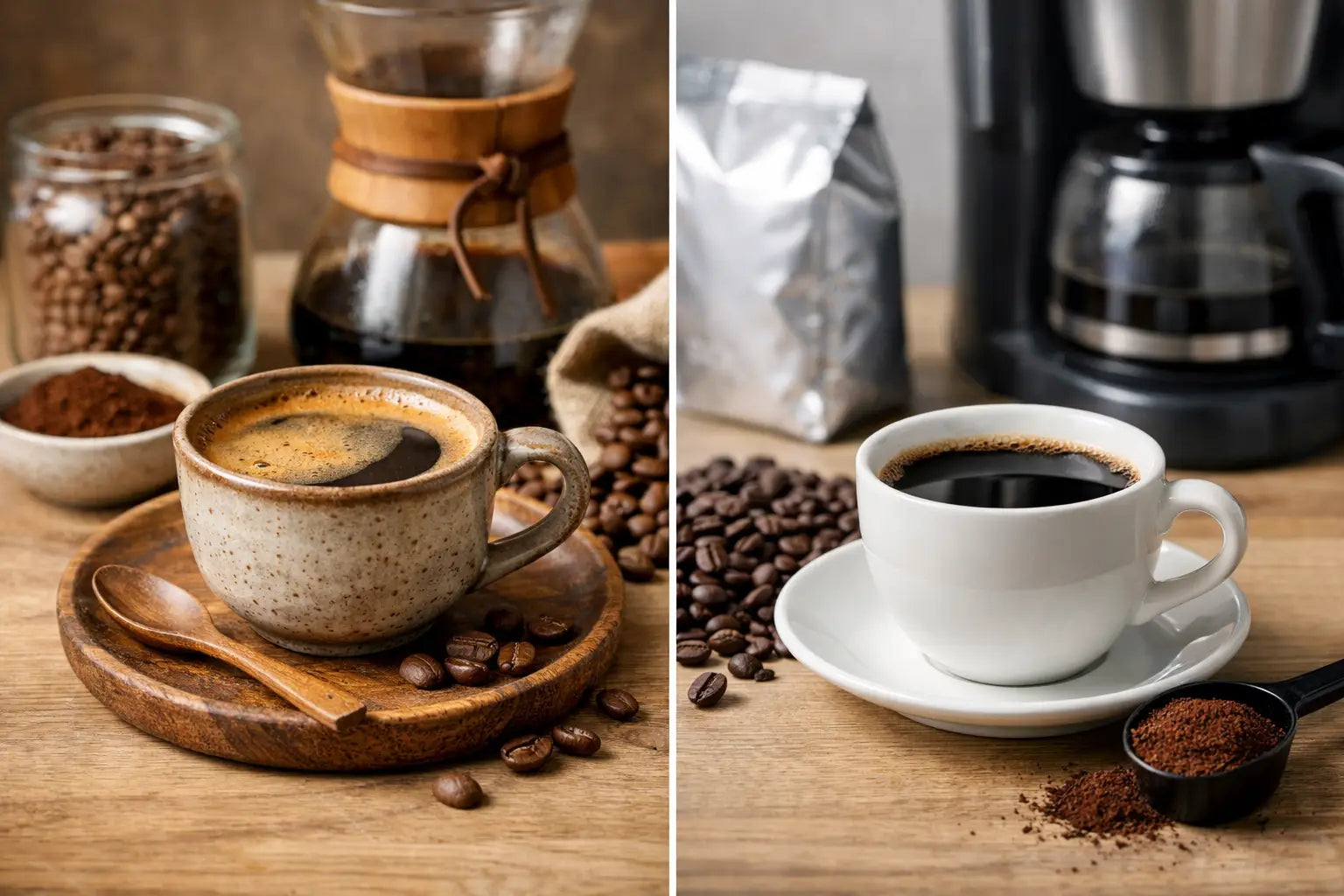
You often taste it from the very first sip: specialty coffee versus supermarket coffee is not a small difference in nuance, but a different product with a different approach. Not only in flavour, but also in freshness, origin, roasting and the seriousness with which quality is treated. Anyone who wants to brew better coffee at home notices the difference sooner than many people expect.
The confusion is understandable. Supermarket shelves now contain bags with terms such as single origin, Arabica and espresso roast. That sounds good, and sometimes the packaging even looks quite premium. But an attractive bag tells you little about what has really happened to the bean — or when.
Specialty coffee versus supermarket coffee starts with the bean
The biggest difference does not begin in your cup, but much earlier. Specialty coffee is selected for quality. This means the beans come from harvests that score highly for flavour, cleanliness and consistency. Defects, processing and traceability are examined more strictly.
With supermarket coffee, the emphasis is usually somewhere else. It is more often about scale, shelf life and a price that remains attractive to a wide audience. That is not a moral judgement, but it is a practical reality. A business producing millions of packages and keeping them in distribution for a long time makes different choices from a roaster working on a small scale with a focus on freshness and flavour.
You can taste that. Specialty coffee often has more layers. Depending on the origin and roast, you may recognise fruit, chocolate, nuts, caramel or floral notes. Supermarket coffee more often tastes flatter, more bitter or more generic. For some drinkers that is familiar. For others, it is exactly why they switch.
Freshness is not just marketing
If coffee has one quiet flavour-maker, it is freshness. Freshly roasted beans contain aromas that slowly fade in the weeks afterwards. That process does not stop because the bag is sealed. Coffee is a natural product and simply loses character over time.
This is one of the clearest differences between specialty coffee and supermarket coffee. Supermarket coffee has to pass through a long chain: roasting, packaging, transport, distribution centre and shelf. By the time you buy the bag, many weeks or months may have passed. You often see a best-before date, but not a roast date. That tells you where the focus lies.
With specialty coffee, the roast date is usually visible because it matters. Not as a gimmick, but because flavour peaks within a certain period. Especially if you brew at home with an automatic coffee machine, espresso machine or filter method, you notice this. Fresher beans give you more aroma, more liveliness and often a better extraction.
Why supermarket coffee often tastes darker
A lot of supermarket coffee is dark roasted. This is not always done only for flavour, but also because a dark roast is easier to keep consistent across large volumes. A dark roast can mask imperfections and produces a profile that many people recognise as “strong coffee”.
There is nothing inherently wrong with that, as long as you know what you are buying. The misunderstanding arises when bitterness and heaviness are treated as signs of quality, even though they can also indicate that the bean’s subtle characteristics have been roasted away.
Specialty roasters try to bring out the coffee’s own characteristics. That does not automatically mean light and sour. It mainly means that the coffee is roasted with more precision. A Brazilian coffee may be creamy and nutty, while an Ethiopian coffee may be fresher and fruitier. The roast supports the bean instead of giving every coffee the same dark signature.
The price is higher — but the whole story matters
Yes, specialty coffee is usually more expensive than supermarket coffee. You see that difference immediately on the price tag. But that is only part of the story. The better question is: what exactly are you paying for?
You are often paying for better selection at origin, smaller production, more quality control, fresher roasting and greater transparency. You are also paying for less mediocrity. That sounds harsh, but it is fair. People who buy cheap coffee often buy a product designed to remain stable for a long time and taste broadly acceptable. People who buy specialty coffee pay for flavour as the main priority.
How you use coffee at home matters too. When you use good beans, you often need less to brew a powerful and balanced cup. And if you drink coffee for enjoyment, a better bean quickly feels more logical than saving on a product you use every day.
At the same time, not everyone has to drink specialty coffee all the time. If you mainly see coffee as a caffeine delivery at 7 a.m. and flavour matters less, supermarket coffee may be perfectly adequate. It depends on your priorities. But if you are looking for better, more consistent and fresher coffee, you soon arrive at specialty.
Packaging and claims do not tell you everything
Supermarkets are strong at marketing. Terms such as premium, intense, gold, barista and extra aroma are everywhere. That makes choosing difficult, especially if you do not yet know what to look for.
So look less at the front of the bag and more at the concrete information. Is there a roast date? Is the origin clear? Does it mention the processing method, altitude or flavour profile? Is there transparency about the coffee itself, or mainly about the experience around it?
With specialty coffee, you usually get more useful information. Not to sound impressive, but because those details matter. They help you understand why a coffee tastes the way it does and which brewing method suits it.
At home, the difference is often bigger than in a café
Many people think you only notice a real difference with expensive equipment. That is only half true. A top machine helps, but the bean remains the foundation. An average supermarket bean does not suddenly become exceptional in a luxury machine. Conversely, a good specialty bean can deliver surprising flavour even in a simple filter setup.
That is good news for home drinkers. You do not have to be a competition-level hobbyist to appreciate better coffee. If your beans are fresh, stored properly and ground reasonably well, you can quickly brew a cup at home that goes beyond the standard.
That is exactly why specialty coffee appeals to so many busy coffee drinkers. You do not want hassle, but you do want good coffee. Quality at the beginning of the process is the smartest gain. A genuinely fresh bean makes more difference than endlessly adjusting details on a product that has already lost much of its character.
Where specialty coffee versus supermarket coffee becomes really interesting
The real difference is not only in flavour, but also in consistency. With specialty coffee, the goal is for a coffee to deliver what it promises. If the bag says you can expect notes of milk chocolate, nuts and caramel, those notes should also appear in your cup — provided you brew it well.
With supermarket coffee, that expectation is often less specific. You buy more on brand trust than on detailed information. As a result, you know less about what you are getting beyond a general style. For some people, that is predictably fine. For others, it feels like a gamble.
Consistency also includes service. If you buy specialty beans online from a supplier that roasts fresh and communicates clearly, you know better what to expect. That removes a barrier, especially if you do not have time to travel around looking for good coffee. For this audience, a brand such as Eddy’s Coffee is interesting: craft quality without complicated fuss.
When supermarket coffee is still a logical choice
To be fair, there are situations in which supermarket coffee is simply convenient. You need something quickly, you are not very particular or you are brewing for a large group where subtlety is less noticeable. In those situations, availability beats finesse.
There are differences within supermarket ranges too. Not every bag is automatically bad. Some coffees are solid, drinkable and better than their reputation suggests. The chance of real freshness, distinctive flavour and complete transparency is simply usually smaller.
So do not see this as black and white. It is not about snobbery, but about expectations. Do you just want coffee, or do you want coffee that genuinely reveals something of the bean, the roast and the craftsmanship behind it?
How to test the difference yourself
The simplest way is to taste them side by side. Brew two coffees using the same method, preferably one after the other. Use a similar strength and pay attention not only to bitterness, but also to aroma, sweetness, body and aftertaste.
Ask yourself which coffee feels more lively. Which one smells good before the first sip. Which one stays with you in a pleasant way. And which one mainly feels dark, flat or dry. A comparison like this makes specialty coffee versus supermarket coffee very concrete.
If you want to change one practical habit afterwards, start with freshly roasted beans and good storage. That often produces results faster than people expect. Good coffee does not have to be complicated — but it does need to be taken seriously.
Share:
How to Buy Fresh Coffee Beans Online
How to Choose Coffee Beans for an Espresso Machine