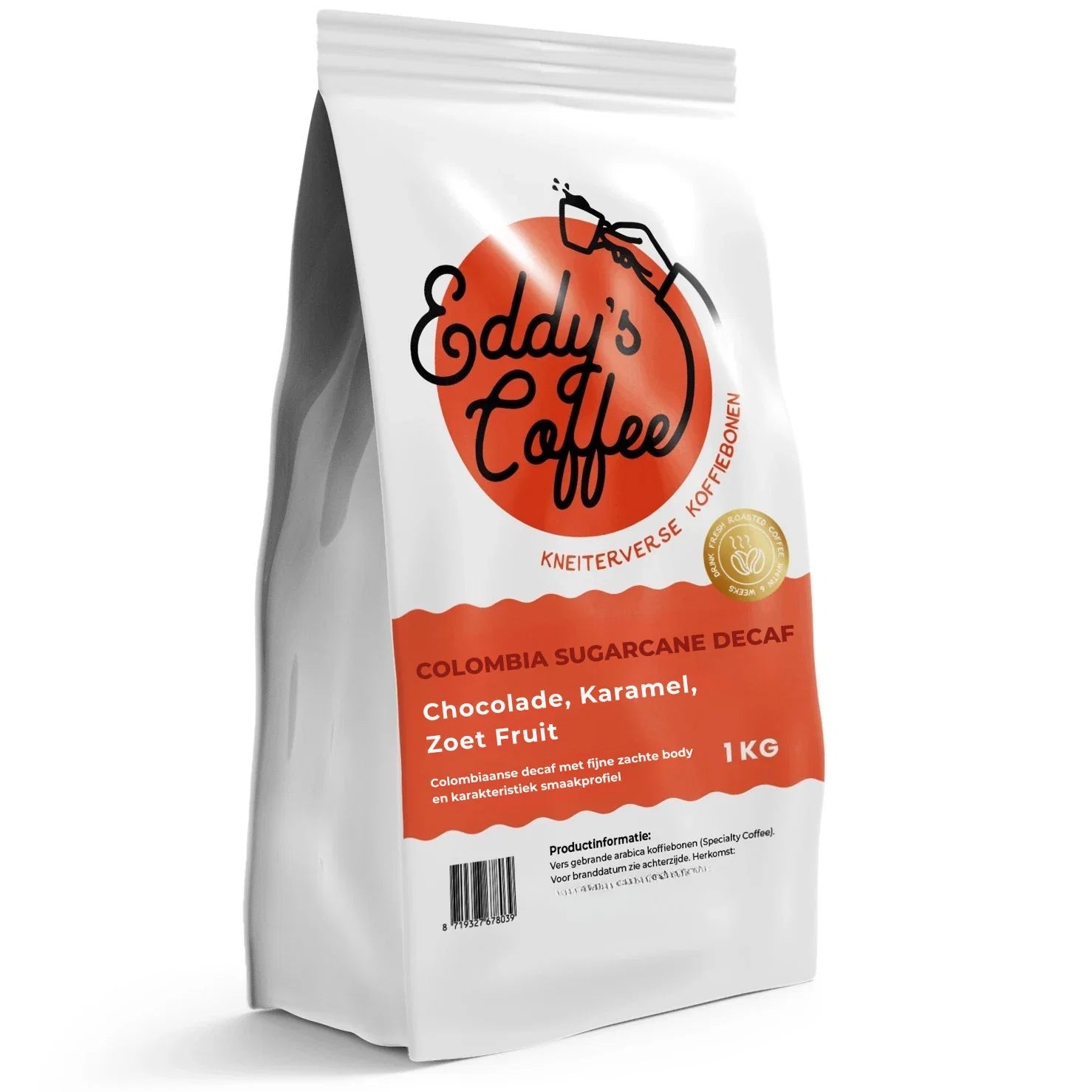
What are Colombia Sugarcane Decaf coffee beans?
Welcome to Eddy’s Coffee. We select coffee the way a barista chooses beans for home: by taste, origin, processing and the way the coffee behaves in the cup. In our decaf coffee collection you will find decaffeinated coffee beans for customers who want to drink less or no caffeine, without settling for a thin or flat flavour. We roast this Colombia Sugarcane Decaf fresh after ordering, so you receive a truly freshly roasted coffee. Order before 23:59 and your coffee will be delivered the day after tomorrow. Would you like to know how customers experience our coffee? You can also read our verified Webwinkelkeur reviews.
When you pair wine with food, you consider body, sweetness, intensity and the way everything stays in balance. Coffee works in much the same way. This Colombia Sugarcane Decaf has a creamy, full body that gives the coffee a satisfying weight without making it heavy. It is complemented by notes of chocolate, caramel and sweet fruit, followed by a soft, sweet finish. The result is a rich, rounded decaf that can also win over people who normally drink caffeinated coffee.
The appeal of this coffee is that reducing caffeine does not mean giving up the experience of a genuine, full-flavoured cup. In the customer feedback we have collected, people repeatedly describe this decaf as full, rounded and never watery. Customers especially mention the soft finish, low bitterness and the way the coffee holds its own in a cappuccino, lungo or other milk drink. As a barista, I see that as an important distinction: a good decaf should be enjoyable black, while still standing up when you add milk or oat milk.
What customers experience
Many customers are surprised when they taste this coffee for the first time. They say it is difficult to notice that it is a decaf and describe it as a real, full cup of coffee: rounded, firm and never watery. That makes this Colombia Sugarcane Decaf interesting for anyone who has previously been disappointed by flat or thin decaffeinated coffee.
The flavour of Colombia Sugarcane Decaf
This Colombia Sugarcane Decaf is creamy and full, with recognisable notes of chocolate, caramel and sweet fruit and a soft, sweet finish. In espresso it gives you a rounded base with enough strength, while filter brewing can make the coffee taste a little lighter and sweeter. The chocolate brings familiarity and comfort; the sweet fruit adds just enough liveliness. The result feels rich and rounded without becoming harshly bitter.
As an espresso, this coffee provides a rounded, full base that pairs naturally with milk. In a cappuccino, flat white or oat-milk drink, the chocolate and caramel profile remains clear, so the drink does not taste only of warm milk. As a lungo or filter coffee, the gentle sweetness comes forward for longer and the coffee has more room to open up. The final flavour is naturally influenced by your grind, dose, water, brewing temperature and machine; that is why I also include practical starting points for different brewing methods on this page.
Colombia Sugarcane Decaf at a glance
- Flavour: chocolate, caramel and sweet fruit
- Body: creamy and full
- Finish: soft and sweet
- Decaf method: Sugarcane process using naturally derived ethyl acetate
- Uses: espresso, lungo, filter coffee, cappuccino, flat white, cafetière and moka pot
- Compatibility: fully automatic machines, semi-automatic machines, portafilter machines and manual brewing methods
- For whom: everyday coffee drinkers and people who normally drink caffeinated coffee but want to avoid or significantly reduce caffeine without a flat flavour; it is also suitable for people who are sensitive to caffeine and still want a full coffee taste
How does the Sugarcane method work?
Sugarcane decaf is a relatively new way of decaffeinating coffee. The process uses ethyl acetate, a compound that occurs naturally in fruit and is obtained from sugar cane for this application. It is not a flavouring added to the coffee afterwards; it is the solvent used to remove caffeine from the green coffee beans.
The green beans are first treated with steam for approximately thirty minutes so that their pores open. They are then placed in a solution containing ethyl acetate. The ethyl acetate binds to caffeine and certain chlorogenic acids. The solution is refreshed repeatedly so that more and more caffeine can be removed from the beans. The complete process takes approximately eight hours.
After this stage, the beans are steamed again to remove any traces of ethyl acetate. They are then dried, polished and packed. The method is designed to preserve as much of the coffee’s original aroma and character as possible. For more background, read what Sugar Cane Decaf is and how decaf coffee is made.
One nuance I always share as a barista: “decaf” means that the caffeine level has been greatly reduced; it does not automatically mean absolutely zero caffeine. If you must avoid caffeine completely, discuss this with a doctor or your coffee supplier.
Product specifications
| Property | Information |
|---|
| Product | Colombia Sugarcane Decaf coffee beans |
| Country | Colombia |
| Decaffeination | Sugarcane process using naturally derived ethyl acetate |
| Flavour profile | Creamy, full body; chocolate; caramel; sweet fruit; soft, sweet finish |
| Sourcing | Direct Trade partnership through Origin Bridge |
| Brewing methods | Espresso, lungo, filter coffee, cappuccino, flat white, cafetière and moka pot |
Which variant suits your brewing method?
You can choose whole beans if you grind them yourself, or a grind suited to your equipment: filter, espresso, cafetière or moka pot. This product page offers 250-gram and 1-kilogram variants; the current stock and delivery time are shown for the selected variant.
If you use a fully automatic machine, choose the option that suits your machine and adjust the grind one step at a time. For a semi-automatic or portafilter machine, espresso grind is the logical starting point. Grinding just before brewing gives you the most control, while the ground options are convenient when you want to skip that step.
How to brew this decaf as espresso
Start with a dose that suits your filter basket and use a fine espresso grind. Pull a double espresso first and taste it without milk. If the coffee is thin or too sharp, grind a little finer or extend the extraction. If it is dry or bitter, grind a little coarser or shorten the extraction. Change one variable at a time; that is the quickest way to discover what your machine needs.
For a cappuccino, flat white or latte, you can brew the espresso slightly more concentrated than when drinking it black. This keeps the full body and the notes of chocolate, caramel and sweet fruit present alongside milk or oat milk. Start with a classic double espresso, taste it first without milk and then add the milk. This matches the customer feedback in which this decaf is often mentioned as a pleasant coffee for milk drinks.
How to brew this decaf as filter coffee
For filter coffee, you can start with approximately 60 grams of coffee per litre of water, or around 15 grams per 250 millilitres. Use a medium grind and clean, fresh water. This ratio gives you a useful first impression of the balance between body, chocolate, caramel and sweet fruit. For more body, grind slightly finer or increase the dose a little. For more clarity and fruity sweetness, grind a little coarser and let the water pass through the coffee calmly. Change one variable at a time so you understand what makes the difference.
This coffee also works well in a cafetière or moka pot when you adapt the grind to the brewing method. The foundation remains the same: a soft, full coffee with chocolate, caramel and sweet fruit as its recognisable anchors.
Cold brew and cold drip
Customer feedback shows that this coffee is also used for cold brew and cold drip. Use a coarse grind, cold water and a longer extraction time. The chocolate base and gentle sweetness remain recognizable with these methods too. Because recipes vary widely, start with a modest coffee-to-water ratio and adjust it to taste.
Freshly roasted at Eddy’s Coffee
We roast this Colombia Sugarcane Decaf fresh at Eddy’s Coffee. After roasting, coffee still needs to degas; especially with espresso, it can therefore help to let the beans rest for a few days before you finalise your recipe. The coffee stays at its best when stored airtight, dry and away from direct sunlight.
Ideally, grind only the amount you need. If you use a fully automatic machine with a hopper of up to 250 grams, that is perfectly practical. Avoid repeatedly topping up old beans with fresh beans and do not leave the machine open and warm for long periods.
More practical tips can be found in our articles about decaf coffee without loss of flavour and caffeine in decaf coffee.
Origin and direct sourcing
This Colombia Sugarcane Decaf comes from Colombia. The coffees are sourced in cooperation with Origin Bridge through a direct-trade approach that focuses on fair prices and transparency. This means that we look not only at the price of a bag of coffee, but also at the relationship with producers, the quality of the harvest and the information available about the coffee. In the cup, that ultimately comes through as a creamy, full, sweet coffee with a pleasant balance.
Origin Bridge describes this coffee as Descaney (#330), a Colombian Sugarcane Decaf produced by Gustavo Zuluaga. The listed varieties are Caturra and Castillo. The accompanying cupping information states a decaf profile with 95% washed and 5% natural processing, a total score of 85 points and a 2025 harvest with crop year 2026. For the flavour, we follow the product promise printed on the bag: chocolate, caramel and sweet fruit. This gives the Colombian decaf a recognisable, rounded and accessible profile that remains enjoyable black or with milk.
When should you choose this decaf, and when an alternative?
Choose Colombia Sugarcane Decaf when you want a decaffeinated coffee that behaves like a full specialty coffee. You get a soft, full body with chocolate, caramel and sweet fruit, a pleasantly sweet finish and enough structure to work both as espresso and in milk drinks. The Sugarcane method is also interesting if you want to understand more about the origin of the decaffeination process and like the idea of a naturally derived ethyl acetate process. If you want one decaf that can be brewed in several ways, this is a versatile choice.
Would you like to compare a different decaf method? Have a look at #1 Peru Swiss Water Decaf Bio. In the decaf collection you can compare the other available decaf products as well. You can also read our explanation of Swiss Water versus Sugar Cane Decaf and the different decaf methods.
Source for origin and cupping information: Origin Bridge – Descaney.