
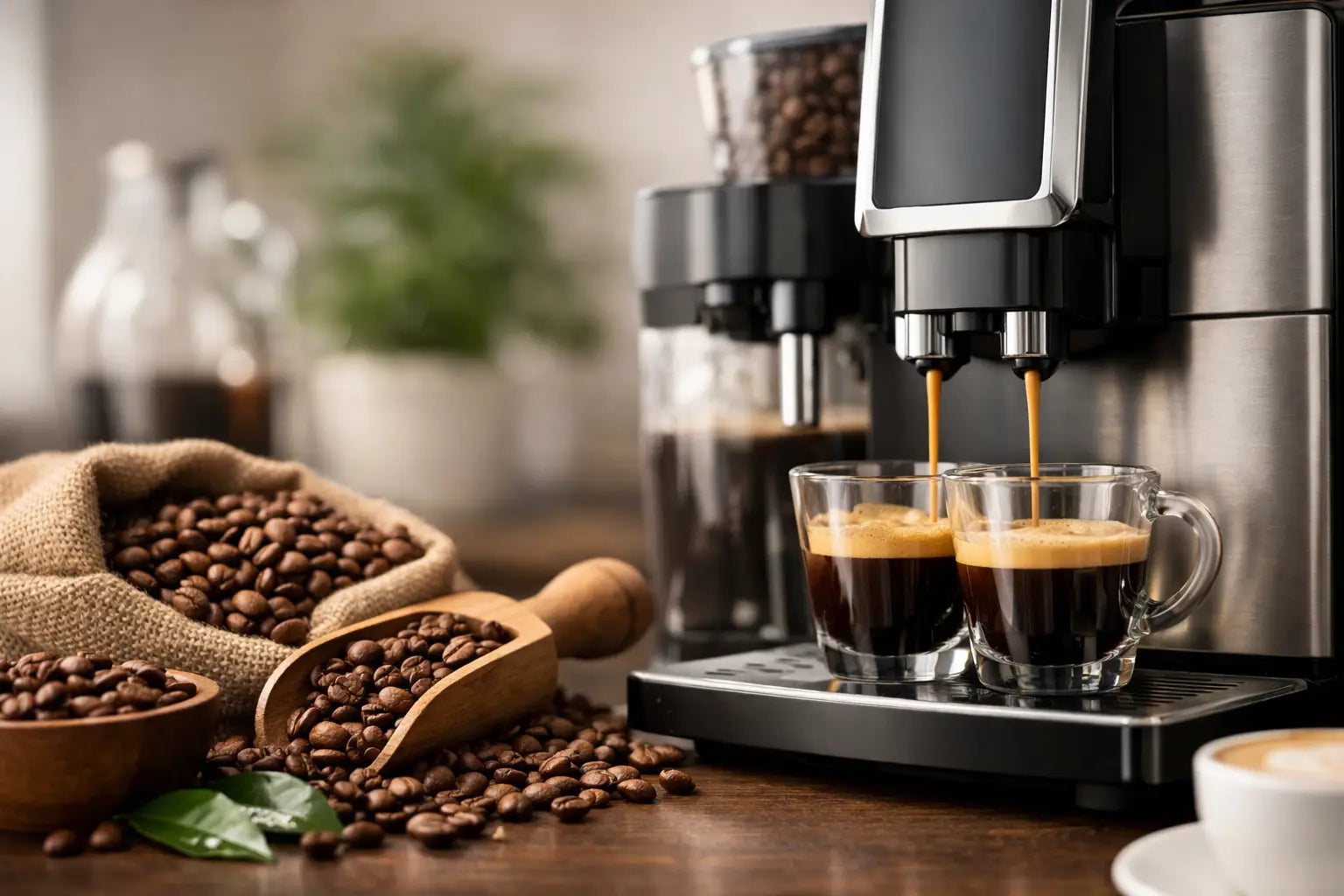
An automatic coffee machine can make excellent coffee, but only when the beans cooperate. Many people search for the best coffee beans for an automatic machine and end up with terms such as strong, mild or extra crema. Useful, but they do not tell you everything. What really matters is how fresh the coffee is, how dark the roast is and whether the bean suits the way an automatic machine extracts coffee.
An automatic machine does a lot for you, but not everything. It grinds, doses and brews within fixed limits. This can make differences between beans especially noticeable. A bean that is just balanced enough in an espresso machine may taste flat, bitter or sour in an automatic machine. Smart choice matters more than many people expect.
Which coffee beans work best in an automatic machine?
The short answer: choose fresh beans with a medium to medium-dark roast and a flavour profile suited to espresso, lungo or milk drinks. Extremely light specialty coffee is often less forgiving in an automatic machine. The machine may not extract enough sweetness, making fruity acidity taste too sharp.
That does not mean light roast is always wrong. If your machine offers good control and you enjoy lively, fresh coffee, it can work well. For most home drinkers, however, beans with more body and notes of chocolate, nuts or caramel are a safer and tastier choice. These flavours match what an automatic machine usually does well.
Beans with a very oily surface are best avoided. They may look attractively dark and shiny, but they can cause more residue in the grinder and brewing unit. Very dark coffee also tends towards smoky and bitter flavours, masking quality rather than adding it.
Why freshness matters more than packaging claims
Packaging often uses words such as intense, crema, strong or barista blend. They may tell you something, but freshness tells you more. Coffee gradually loses aroma and liveliness after roasting. In an automatic machine, you notice this quickly: less aroma, thinner crema and a flatter cup than expected.
Genuinely fresh beans usually provide more sweetness, aroma and balance. That does not mean beans are perfect on day one. Many coffees taste better a few days after roasting. But beans that have spent months in a distribution chain are almost always behind freshly roasted coffee.
At home, do not look only at the best-before date. Look for a roast date. This gives you a much better idea of what you are buying. With daily use of an automatic machine, the difference between old and fresh beans is a major part of the result.
Arabica, robusta or a blend?
There is a lot of confusion here. Arabica is often presented as better and robusta as inferior, but it is not that simple. Good Arabica often gives more nuance, sweetness and aromatic complexity. Robusta can add body, crema and extra punch.
Blends are often a very logical choice for automatic machines. A blend made mainly from Arabica with a small amount of robusta can work excellently if you enjoy powerful espresso or cappuccino. The robusta adds texture and intensity without making the coffee harsh or heavy.
If you mainly drink black coffee and want refinement, 100% Arabica may be more interesting. If you drink many milk coffees, a blend may hold up better against milk. It is less about what sounds most premium on paper and more about what you want from your machine and cup.
Roast level: not too light, not too dark
Roast level largely determines how easy a bean is to use in an automatic machine. Very light coffee can cause under-extraction. You taste citrus-like sharpness, little body and an empty finish. The bean is not necessarily bad, but it may be a difficult match.
Very dark beans sit at the other end of the spectrum. They produce bitterness, burnt notes and oil more quickly. Dark coffee may initially feel powerful, but often becomes monotonous over time. You mainly taste the roast, not the coffee itself.
Medium or medium-dark is therefore usually the sweet spot. You get enough body and chocolate depth, with plenty of sweetness and character. For an automatic machine, this is often where convenience and flavour work best together.
Choose a flavour profile based on how you drink
If you mainly drink espresso or ristretto, look for compactness, sweetness and a full finish. Think dark chocolate, hazelnut, caramel or gentle spice. These profiles work well in automatic machines because the machine can extract body and balance from them easily.
If you mainly drink lungo or Americano, avoid beans that are too heavy or bitter. Chocolate and nuts can still be excellent, but a little more freshness or red fruit can be pleasant. Otherwise the cup may become long but dull.
For cappuccino and latte macchiato, you need beans that come through the milk. Very subtle coffee simply disappears. Cacao, nuts, nougat or a more developed roast often work better than very floral or tea-like profiles.
Machine settings can make or break the bean
Even the right bean can disappoint when your automatic machine is poorly adjusted. Too fine a grind often produces bitterness or a slow flow. Too coarse makes the coffee watery and sour. Many people blame the bean when the grind size is actually the cause.
Make small adjustments. Do not change strength, grind and water volume all at once. Test calmly and give a new setting two or three cups, because old grounds may still be in the system.
With fresh specialty beans, prefer a slightly shorter coffee rather than a very large lungo from one puck. Automatic machines often perform better with compact extractions. If you want more volume, add hot water for an Americano. This usually gives a cleaner taste.
Common mistakes with beans for automatic machines
The biggest mistake is buying based only on the strength number on the package. Such a scale says little about quality or suitability. It is often mainly marketing language for a darker roast. Strong does not automatically mean tasty.
Another mistake is buying too many beans at once without storing them well. After opening, oxygen, light, heat and moisture reduce aroma more quickly. If you switch beans occasionally, smaller amounts that you finish in good time are better.
Storage in the hopper is also underestimated. The hopper is convenient, but not intended as long-term storage. Fill it with what you will use over the next few days and keep the rest airtight, dark and cool. Not in the fridge, because moisture and odours are harmful.
How to tell that a bean does not suit your machine
Does the coffee remain thin, sour or weak even after adjusting the grind? The roast may be too light for your machine. Do you get constant bitterness, ash-like notes and a lot of oily residue? You are probably using a roast that is too dark.
Sometimes the flavour is acceptable but lacks energy. Freshness is often the suspect. Old beans still produce coffee, but not the lively cup you bought better beans for. An automatic machine can do a lot, but it cannot restore aroma that has already disappeared.
Consistency matters too. Good beans should not produce a great cup one day and a dull one the next without a clear reason. If the machine is clean and the settings are unchanged, the result should be stable. This is exactly why freshly roasted quality makes such a difference.
What is a sensible choice?
For most people, a fresh specialty blend with a medium to medium-dark roast is the best starting point. Choose a bean developed for espresso with enough body for black coffee and milk drinks. This puts you in a safe zone where an automatic machine can perform well.
If you want to fine-tune further, consider when you drink your coffee. Morning coffee can be approachable and rounded, while an after-dinner espresso may be more intense and deep. If several people drink coffee at home, an all-round blend is usually smarter than a highly distinctive single origin.
At Eddy’s Coffee, we believe good coffee at home does not need to be complicated. It does need to be fresh, honestly roasted and suited to how you really drink it. That sounds simple, and it is.
The best bean for an automatic machine is not the most expensive, darkest or most hyped. It is the bean that is fresh, well roasted and gives you a cup you genuinely look forward to every morning.
Share:
How to Choose Decaf Beans for Espresso Without Losing Flavour
How to Choose Coffee Beans That Truly Suit You