
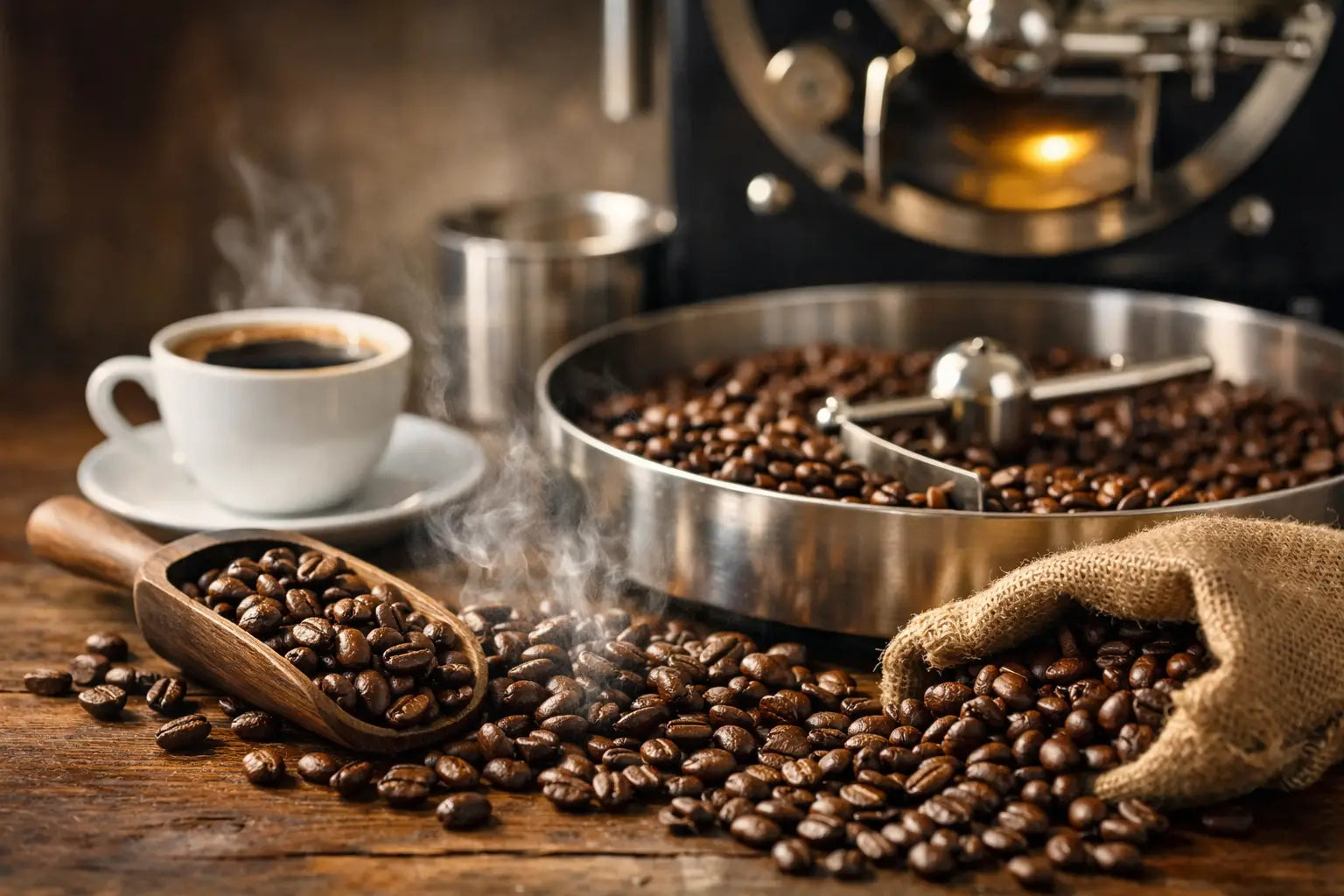
You can smell it immediately when a bag of genuinely fresh beans is opened. Not the flat, slightly dusty coffee smell you often get from supermarket packaging, but a full aroma of chocolate, nuts, fruit or caramel. That is where the benefits of freshly roasted coffee begin. Not as a marketing term, but simply in your cup. Anyone who wants to brew better coffee at home often notices a bigger difference from freshness than from buying a more expensive machine.
Why the benefits of freshly roasted coffee are noticeable
Coffee is not a shelf-stable flavour block that remains unchanged for months. As soon as beans are roasted, all kinds of things begin to happen. Gases are released, aromas develop and then freshness slowly declines. You cannot stop this process, only slow it down. That is why coffee roasted recently usually tastes more lively, sweeter and clearer.
With fresh roasting, volatile aromatic compounds are still more present. You notice this especially in the aroma and complexity of the flavour. Espresso gets more body and filter coffee more often reveals clear tasting notes. Think red fruit, citrus, cacao or almond, depending on the bean and roast.
That does not mean coffee is always perfect on day one. Very fresh beans often contain a lot of carbon dioxide. This can make extraction unsettled, especially for espresso. The ideal drinking window is often a few days after roasting, once the coffee has rested and then reaches a period when it tastes its best. Freshness matters, but fresh enough and properly developed is even better.
Flavour, aroma and balance in the cup
The biggest advantage of freshly roasted coffee is simple: more flavour. Not necessarily louder or more bitter, but more precise. Good fresh coffee often tastes sweeter and cleaner. Bitterness feels less dominant, while acidity can be fresher and better balanced.
This is because flavour components do not remain stable forever after roasting. Over time, the finer notes fade first. What remains is usually a flatter profile. You still taste coffee, but less distinction. An Ethiopian bean may lose its floral character, a Brazilian bean its creamy nuttiness and a blend may simply become less interesting.
For home drinkers, that is a major difference. You do not need to be a professional cupper to notice it. Even people who mainly drink cappuccino or an Americano can taste that fresh coffee has more depth. Milk hides a lot, but not everything. When the foundation is better, the whole cup is better.
Benefits of freshly roasted coffee for espresso and filter
The benefits are not exactly the same for every brewing method. With espresso, freshness strongly affects crema, extraction time and body. Beans that are too old often offer less resistance, producing a shot that runs faster and tastes flatter. The crema looks thinner and the espresso lacks energy.
With filter coffee, you notice something different. It is less about pressure and more about clarity and nuance. Fresh beans show the effects of origin and roast more clearly in a filter brew. You taste more layers and the finish lingers longer. That is exactly why many coffee lovers switch from old supermarket beans to specialty coffee and immediately think: this is a different drink.
With both methods, your grind still needs to be right. Fresh coffee may behave differently in your grinder and recipe. You may need to grind a little finer or coarser to achieve the right extraction. That is not a disadvantage, but it is something to consider if you want consistently good results.
Less dependence on tricks during brewing
When beans are fresh and high quality, you have to compensate less with your brewing method. This sounds minor, but it is very convenient in practice. You do not need to grind extremely fine to squeeze some body from old beans or use hotter water to give dull coffee more strength.
Fresh coffee gives you a better starting position. As a result, making coffee at home becomes not only tastier, but also more predictable. This is especially useful for people with busy working days. You do not want a morning ritual in which every cup is a gamble.
Freshness does not solve everything, of course. Bad beans remain bad even if they were roasted yesterday. A wrong grind or poor storage can also ruin good coffee. But when quality and freshness are both right, brewing well becomes much easier.
The difference from supermarket beans
Many supermarket beans have one major problem: you often do not know when they were roasted. There is usually a best-before date, but that says little about when the coffee was at its best. The beans may have spent months moving through storage, distribution and the shop shelf before you bought them.
That long journey costs flavour, not all at once but little by little. The result can still be perfectly drinkable, but rarely truly vibrant. If you mainly want strong coffee, that may seem sufficient. If you want to drink genuinely better coffee at home, it is usually the bottleneck.
Freshly roasted specialty coffee takes a different approach. Not only through a more recent roast date, but often through better bean selection too. You get a double benefit: higher quality and more freshness. That explains why many people do not want to go back after trying one good bag.
How long does freshly roasted coffee stay good?
People often treat this too much as a black-and-white issue. Coffee does not become perfect on day 15 and worthless on day 16. It is a gradual scale. You usually get the best results during the weeks after roasting, depending on the bean, roast and packaging.
Lightly roasted coffee often needs a little more resting time than darker roasts. Espresso usually requires more attention to degassing than filter coffee. Whole beans also stay good for longer than pre-ground coffee because less surface area is exposed to oxygen.
For home use, the practical rule is: buy whole beans, use them within a sensible period and store them properly. Not in the fridge, not open on the counter and certainly not in transparent packaging in full sunlight. Air, light, heat and moisture are the four major flavour killers.
Storage makes or breaks freshness
A common mistake is investing in good coffee and then storing it carelessly. You lose flavour without realising it. A sealed, lightproof storage container really helps, especially when you buy a larger order.
There is nuance here too. Transferring beans to a container is only smart if that container closes properly and the beans are not repeatedly exposed to a lot of new air. Sometimes the original valve bag is already very useful, as long as you close it neatly and store it somewhere cool.
Anyone who drinks coffee every day notices that good storage matters most during weeks two and three. The coffee stays lively for longer and the flavour declines less quickly. It is not spectacular, but it is practical. Those details are exactly what make the difference between a decent and a genuinely good cup at home.
Who benefits most from freshly roasted coffee?
Anyone who wants more from coffee can benefit, but some drinkers notice it especially strongly. Espresso fans see the difference more quickly in extraction and body. Filter drinkers taste more detail and origin. People who drink black coffee notice every deviation more readily than those who use lots of milk and syrup.
Freshness also matters greatly to people who order online. If you do not have time to visit a local roaster regularly, you still want confidence that your beans have not already passed their best. This is where a webshop with clear freshness promises adds value. Not because online is automatically better, but because convenience only has real value when quality remains intact.
For people new to coffee, there is another benefit. Fresh coffee helps you understand what you actually like. When flavours are clearer, you learn more quickly to distinguish chocolate-like, fruity, spicy or nutty profiles. That makes your next purchase easier.
When fresh does not automatically feel better
There are situations in which the benefit is less immediate. If you drink very little coffee and take weeks to finish a bag, your usage pattern may matter more than an ultra-recent roast date. In that case, it is better to buy smaller amounts.
If your machine is poorly adjusted or your water quality is mediocre, you will not get everything from fresh beans either. The coffee is still better, but the effect feels smaller than it could. Freshness works best together with a decent grinder, a suitable recipe and proper storage.
Fortunately, that does not have to be elitist or complicated. You do not need a café setup to taste the difference. A good hand or electric grinder, fresh beans and a little attention already take you surprisingly far.
Once you notice the benefits of freshly roasted coffee, you start buying, storing and brewing differently. Not obsessively, but more consciously. That is exactly where better coffee at home begins: with beans that still have something to say when you open the bag.
Share:
CoffeeVac Review for Coffee Beans: Does It Work?
Buy Coffee Beans with Fast Delivery