
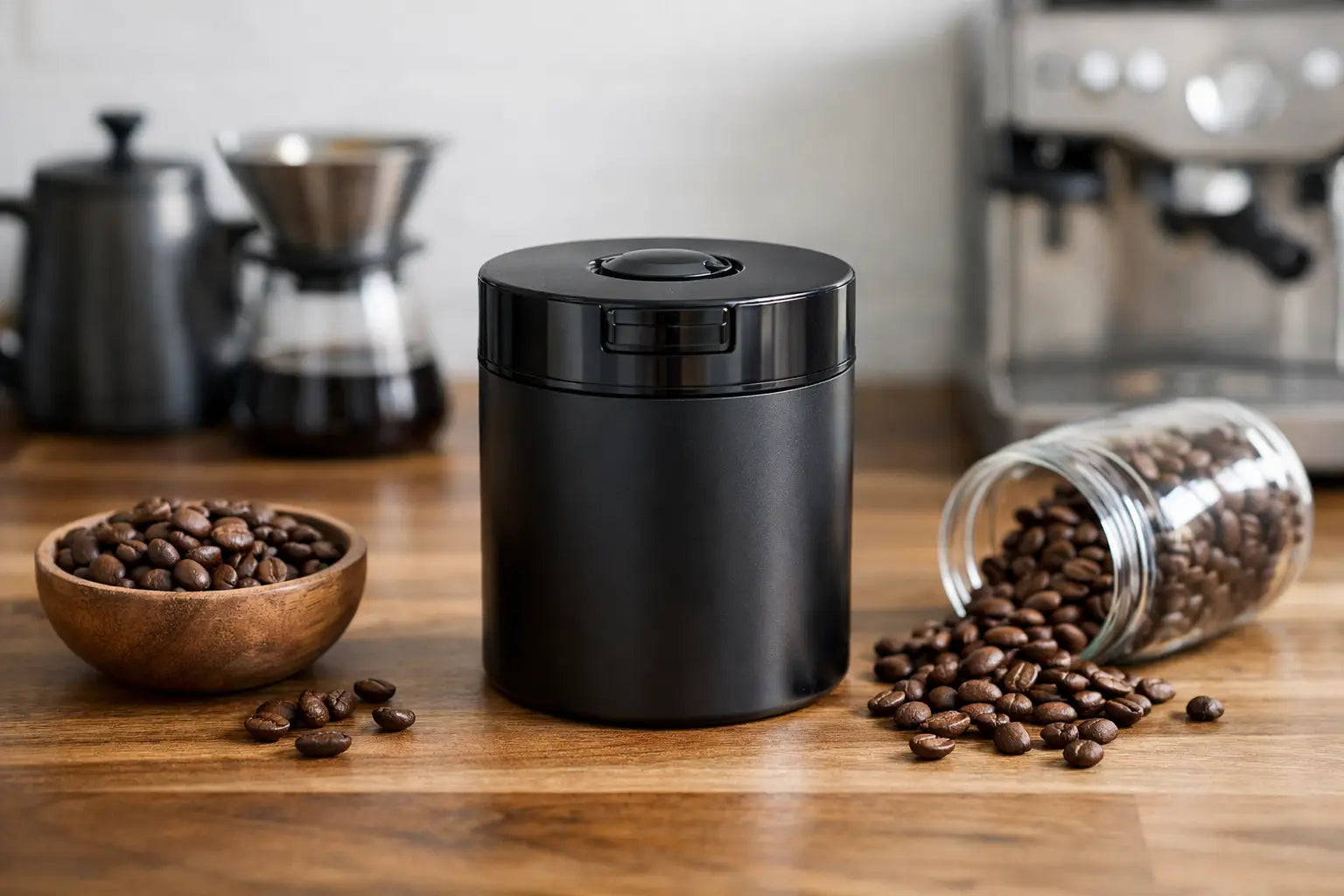
You buy genuinely fresh coffee beans, open the bag and notice a difference three days later. Less aroma, less energy in the crema and a cup that feels just a little flatter. That is exactly why a CoffeeVac review for coffee beans is relevant: not because a storage canister adds magic, but because poor storage destroys freshness faster than many home baristas realise.
The CoffeeVac is not a luxury gadget for the kitchen counter. In practice, it is a simple solution to a simple problem: air is coffee’s enemy. Especially when you buy good beans and do not want that quality to disappear within a week. The question is therefore not whether you should store your beans somewhere, but whether the CoffeeVac does that better than the original bag, a basic household storage jar or any container with a clip lid.
CoffeeVac review for coffee beans: what exactly is it?
The CoffeeVac is a plastic storage container with a lid that does more than simply close. It actively lets air escape when you seal it. The idea is simple: less oxygen remains in the container than in a standard storage jar. Less oxygen means slower oxidation, and oxidation is exactly what removes coffee’s aromas.
This makes the CoffeeVac especially interesting for people who buy whole beans. Ground coffee loses flavour even faster, but anyone who buys specialty beans and grinds just before brewing wants to preserve as much aroma and complexity as possible. Every step that limits exposure to air helps.
It is important to be clear: a CoffeeVac is not a vacuum sealer. It does not create a professional vacuum like industrial packaging. The name can sometimes suggest that, but in use you should see it as a smart storage container that reduces air rather than eliminating it.
What do you notice in practice?
With coffee accessories, only one thing matters: can you taste a difference? In many cases, yes, although it depends on how you currently store your beans. If you already keep them in a good, well-sealed valve bag and carefully squeeze the air out each time, the step to a CoffeeVac is smaller. If you leave a bag half open, scoop from it daily and loosely roll it closed, you will notice a clear improvement.
You especially see where the CoffeeVac helps during weeks two and three. The beans smell lively for longer when you open the container, and espresso often remains more stable. That is more important to many coffee drinkers than aroma alone. Fresh beans respond strongly to small changes in air and moisture. As the beans age faster, you need to adjust your grind more often and your shot becomes less predictable.
With filter coffee, the effect is subtler but still noticeable. Floral and fruity notes generally remain present for longer. Chocolatey, nutty coffees are more forgiving, so the benefit can feel less dramatic. Even there, however, better storage is rarely a bad investment when the contents are good enough.
The CoffeeVac’s strengths
The biggest advantage is ease of use. You do not need a pump, replace bags or think about complicated steps. Put on the lid, press it down briefly and you are done. That makes it more likely that you will actually use it correctly every day.
The size is also convenient for home use. A standard CoffeeVac holds the amounts many home drinkers actually buy without leaving you with a huge bulk container on the counter. It also helps protect the beans from light if you choose an opaque version or keep it in a cupboard.
Another advantage is that it closes more consistently than many generic storage containers. Cheap jars look closed, but often let just enough air through to make a difference over time. With coffee, you notice this more quickly than with pasta or rice.
The CoffeeVac is also easy to keep clean. That sounds minor, but you do not want old coffee residue and oil build-up in a storage container. A container that is easy to clean remains more pleasant to use in the long term.
What are the disadvantages?
An honest CoffeeVac review for coffee beans also needs to mention its limitations. The first is the material. Most CoffeeVac models are made from plastic. This is light and functional, but not everyone finds it premium. Especially in a minimalist kitchen, some people prefer glass or metal.
The second disadvantage is that the benefit is not equally large for everyone. If you buy small amounts of coffee and finish them within seven to ten days, the difference is more limited. Good coffee that is consumed quickly simply has less time to deteriorate. A decent resealable coffee bag may be enough.
It is also important to understand that a CoffeeVac does not completely fix bad habits. Put it in the sun, above a warm oven or in a damp place and you are working against the system. Heat, light, oxygen and moisture remain the four major enemies. The container mainly addresses one of them: air.
Finally, there is the price question. A CoffeeVac is not a huge expense, but it does cost more than a standard storage jar. That is easy to justify if you regularly buy specialty coffee. If you mainly drink ordinary supermarket beans and care less about how the coffee develops, the benefit will probably feel smaller.
Who should consider buying one?
The CoffeeVac is especially interesting for three types of coffee drinkers. First, anyone who buys better-quality beans and does not want to lose half of their investment through poor storage. If you consciously choose freshly roasted coffee, proper storage is simply part of that choice.
Second, it is useful for people who order larger quantities. This is common among people working from home, busy professionals and households where several cups are brewed every day. You want to keep a supply at home without the last beans tasting noticeably worse than the first.
Third, it is smart for espresso fans. Espresso reacts more sensitively to age than many people realise. A bean that has lost some energy quickly shows it in extraction time, body and crema. Stable storage is then not a detail, but part of your workflow.
If you are an occasional coffee drinker who opens one bag a month and pays little attention to flavour nuance, the need is smaller. It may still be convenient, but it is not likely to be a game changer.
How does the CoffeeVac compare with other storage methods?
The original coffee bag is often better than it looks, provided it is a good bag with a valve and a sturdy closure. Many roasters package beans this way deliberately because freshly roasted coffee continues to release gas. During the first days after roasting, such a bag works perfectly well. The disadvantage begins when you open it frequently. Each time, new air enters and resealing becomes more important.
A glass storage jar looks attractive, but is rarely the best option for coffee. Glass lets light through and many lids are less airtight than you hope. Fine for biscuits, less ideal for good beans.
Metal canisters often perform better, especially when they block light and close well. The difference, however, is often in the lid construction. This is where the CoffeeVac usually wins in ease of use and active air release.
If you want to get the most from freshness, dividing your supply also works well. Keep some beans in daily use and store the rest sealed and untouched. People who take this seriously sometimes combine a CoffeeVac for the week’s supply with the rest still sealed in its original packaging.
How to use a CoffeeVac properly
A good container only helps when you use it intelligently. Do not keep adding new and old beans together. Empty and clean the container before adding a fresh batch. You do not want old oil and stale air carried over into your new coffee.
Store the container somewhere cool and dark. Not in the fridge, because that is more likely to create moisture problems than improve the coffee. A kitchen cupboard or a place away from direct sunlight is usually best.
Do not automatically buy the largest size either. Too much empty space means more air around the beans. A size that reasonably matches your usage is often smarter than one oversized container for every situation.
If you pay close attention to detail, keep part of the coffee separate and open it later. This is especially useful when you buy a kilo because you do not want to miss out on your favourite beans. Good storage does not begin only once everything is open; it also begins with how you divide your supply.
Our verdict in this CoffeeVac review for coffee beans
The CoffeeVac does not pretend to make coffee fresher than fresh. That is exactly why it is useful. It does not try to solve a problem that does not exist, but slows down a problem that does: quality loss after opening.
Is it the only good storage method? No. Is it essential for every coffee drinker? No. But for anyone who regularly buys good beans, values flavour and does not want to rely on half-hearted solutions, it is a smart and practical choice. Especially when you do not finish your coffee within three days.
The real benefit is not in marketing terms, but in consistency. Your beans stay lively for longer, your brewing remains more stable and you get more from what you have already bought. That is what good storage is ultimately about: not more things on the counter, but more flavour in the cup.
Share:
How to Choose the Best Coffee Beans for Cappuccino
The Benefits of Freshly Roasted Coffee Explained