
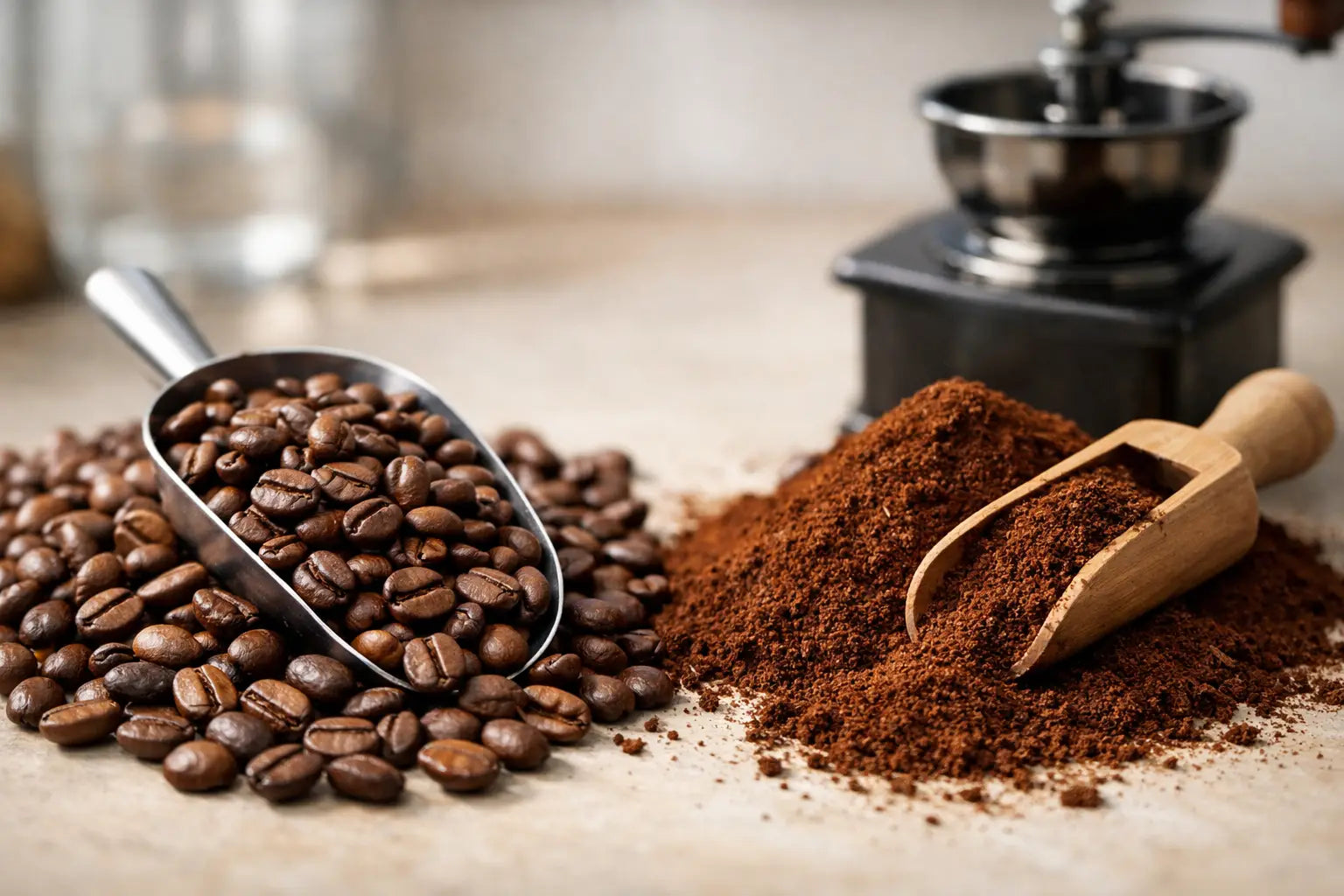
You often taste it from the first sip: whole-bean or ground coffee is not merely a practical difference. It determines how much aroma reaches your cup, how much control you have over flavour and how fresh your coffee really stays. Anyone who wants to brew better coffee at home sooner or later faces the same question: should you choose whole beans or ground coffee?
The honest answer is less black and white than some coffee snobs suggest. Whole beans are the best choice in most situations, but not always the smartest. It depends on how you brew, how often you drink coffee and how much effort you accept in your morning routine.
Whole beans or ground coffee: what is the real difference?
The biggest difference is freshness. As soon as coffee is ground, much more surface area comes into contact with oxygen. That is bad news for aroma and flavour. The fresh, complex aromas that give specialty coffee its advantage disappear faster than most people realise.
With whole beans, that process is much slower. The coffee therefore stays at its best for longer, especially if you store it properly in an airtight canister and do not leave it in a warm, bright corner of the kitchen. If you grind just before brewing, you simply get more from the same coffee.
Whole beans also give you more control over extraction. That sounds technical, but it is practical. Grind size determines how quickly water draws flavour from the coffee. Too coarse and your coffee becomes weak or sour. Too fine and it becomes bitter or syrupy. With whole beans, you can adjust. With pre-ground coffee, you are tied to one setting, even though every machine and brewing method does not require the same one.
When whole beans are clearly the better choice
If you have an automatic coffee machine, espresso machine, filter setup or hand grinder, whole beans are almost always the logical choice. Not because they sound more luxurious, but because that is when you notice the greatest difference in flavour. Especially with specialty coffee, where origin, roast and freshness really matter, you do not want to lose those aromas before the water reaches the coffee.
This is even clearer with espresso. Espresso is sensitive. A small change in grind size can be enough to throw your shot out of balance. A little finer today, a little coarser tomorrow — those small corrections make the difference between a flat shot and a great one. With pre-ground coffee, you lose that flexibility.
Whole beans are also more convenient if you switch between brewing methods. The grind for espresso is completely different from the grind for a French press or filter coffee. If you buy one bag of pre-ground coffee, it is usually prepared for one use. Whole beans give you freedom, and you can taste that freedom.
When ground coffee is a perfectly logical choice
Ground coffee is not automatically an inferior choice. If you do not have a grinder and do not want to buy one, good pre-ground coffee is still better than old supermarket beans that have been losing flavour for months. Especially if you finish a bag relatively quickly, pre-ground coffee can work perfectly well.
Convenience matters on busy mornings too. Not everyone wants to grind, weigh and dial in coffee before the working day begins. Sometimes you just want good coffee without extra steps. There is nothing wrong with that. The best coffee solution is ultimately the one you actually use.
Ground coffee can also be sensible when you are just starting out. For many people, a better bean is already a huge step forward. You do not have to tackle everything at once. First get used to fresher coffee and a better brewing method, then invest in a grinder — that is often more realistic than buying the complete setup immediately.
The main disadvantage of ground coffee is time
The problem with ground coffee is therefore not mainly its quality at the time of purchase, but what happens afterwards. A bag may still be perfectly good when delivered, but the flavour fades faster after opening. The subtle notes disappear first. What remains is usually a flatter cup with less sweetness and liveliness.
How quickly this happens depends on the packaging, storage method and coffee. In practice, however, if you take your time finishing a bag, whole beans almost always work better. If you drink a lot and finish a bag in a few days, the difference becomes smaller.
That is the nuance. If you buy carefully and consume it quickly, you can still be very happy with ground coffee. If you want maximum flavour from every cup, you usually end up choosing whole beans.
Whole beans or ground coffee by brewing method
For espresso and automatic machines, whole beans have the strongest advantage. These brewing methods respond sensitively to grind size, freshness and extraction time. Small adjustments have a big effect, so grinding fresh pays off most here.
With filter coffee the difference is a little less dramatic, but you still notice it. A V60, Chemex or classic filter machine benefits from a consistent grind that suits your recipe and brewing time. Whole beans give you more control, while pre-ground coffee is mainly useful when simplicity is your priority.
With a French press, you can get away with pre-ground coffee more easily as long as the grind is coarse enough. If it is too fine, you get more sediment and often a harsher flavour. This shows why the right grind is not merely a technical detail.
A moka pot is different again. It sits somewhere between espresso and filter coffee. Too coarse gives you little body, while too fine quickly becomes sharp or bitter. Grinding fresh helps here too, although well-matched pre-ground coffee can still produce beautiful results.
What is smarter if freshness is your priority?
Whole beans are the winner. Full stop. Freshness is one of coffee’s biggest flavour factors, and whole beans simply preserve it better. Especially with coffee that takes genuinely fresh roasting seriously, you do not want to lose flavour unnecessarily during the days after opening.
That does not mean you have no chance with ground coffee. Store it airtight, in the dark and at room temperature. Buy smaller amounts rather than a large bag that stays open for weeks. And have the grind matched to your brewing method, so you are not starting at a disadvantage.
What about cost and convenience?
Ground coffee often wins in the short term. You do not need to buy a grinder and you are ready more quickly. For many households, that is a perfectly good trade-off. Especially if coffee simply needs to be reliably good and does not need to be optimised every time.
In the long term, the picture is more nuanced. A good grinder costs money, but it also helps you get more from every bag of coffee. You waste less potential and can adjust more effectively when a bean behaves differently than expected. Anyone who regularly drinks specialty coffee notices that difference quickly enough to justify the investment.
The real question is therefore not just flavour versus convenience. It is also how much you value control. Some people just want a strong, pleasant cup without fuss. Others want to taste what a bean can really do. Both are valid, but they lead to a different choice.
What we usually recommend
If you want to drink noticeably better coffee at home, choose whole beans. Not as a matter of principle, but because you gain the most freshness, flexibility and flavour. Especially if you have or plan to buy a good grinder, this is the step that delivers the most.
If you do not have a grinder and mainly want convenience without compromising the basics, ground coffee is a good intermediate step. Choose coffee that was freshly roasted, have the grind matched to your brewing method and do not buy more than you can drink in a reasonable time. That is much smarter than choosing convenience blindly and then being disappointed by the result.
For many Eddy’s Coffee customers, the journey works like this: first switch to better, fresher coffee, then fine-tune with grind size and brewing method. That is not a compromise, but simply a logical route.
The best choice between whole beans and ground coffee is therefore not the one that sounds best on paper, but the one that produces a better cup every morning at home. If flavour comes first, choose whole beans. If convenience helps you drink consistently good coffee, ground coffee is still a strong choice. As long as you choose consciously — that is where better coffee always begins.
Share:
A Specialty Coffee Guide for Home Drinkers
How to Order Freshly Roasted Coffee Without Guesswork