
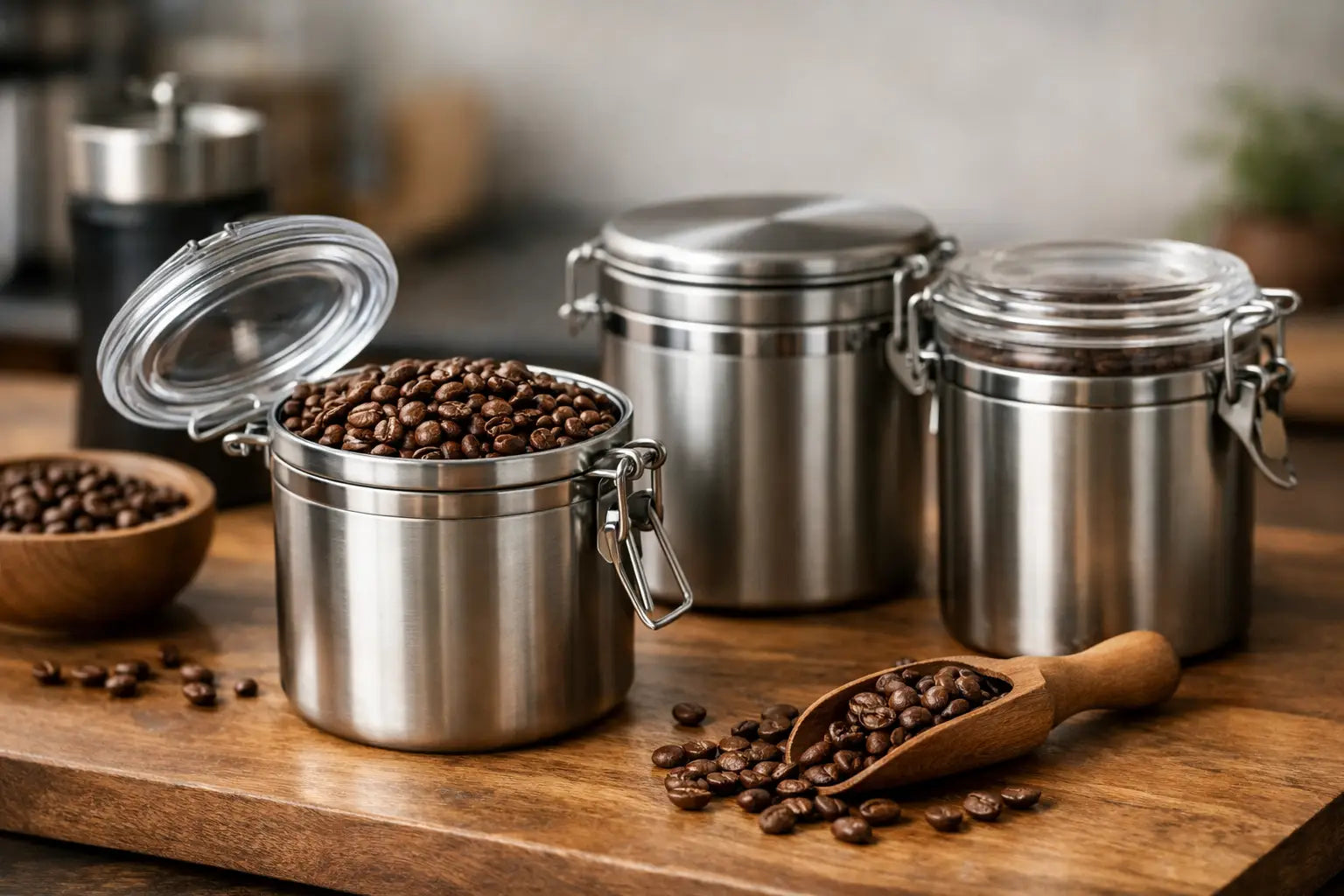
You buy seriously fresh beans, grind them carefully, dial in your machine—and yet your coffee tastes flatter after a week. The problem is often not the bean but the storage method. A good coffee canister is not a detail for enthusiasts; it is simply a sensible foundation if you want to drink better coffee at home.
Why a coffee canister makes a difference
Coffee beans are sensitive. Once roasted, the ageing process begins. That is normal, but oxygen, light, heat and moisture speed it up considerably. This is exactly where things often go wrong at home. Beans remain in a half-open bag on the worktop, next to a warm appliance or in a cupboard that is constantly opened and closed. You lose flavour without noticing.
A coffee canister helps by keeping the biggest enemies of freshness out. Not every canister does this equally well, but the principle is simple: less contact with air and light means longer preservation of aroma, body and nuance. You notice the difference especially quickly with specialty coffee. Fruity Ethiopian coffee becomes duller, chocolatey Brazilian coffee loses depth and a beautiful espresso blend becomes flat or even stale when stored carelessly.
That does not mean a canister keeps coffee fresh forever. It does not work that way. A coffee canister slows the loss of quality. The combination of fresh roasting and good storage is where you gain the most.
What should a good coffee canister be able to do?
When you search online, the problem becomes obvious: almost everything is called an “aroma canister” or “storage container”, but not everything is suitable for coffee. A beautiful container is not automatically a good coffee canister.
The most important factor is the seal. You want a canister that closes properly so as little new oxygen as possible gets in. A loose lid may look sleek, but often does too little for coffee. A canister with a reliable seal or vacuum system is usually much better.
The material matters too. Stainless steel is popular for good reason. It is sturdy, blocks light and does not absorb odours in the way some plastics can. Glass looks attractive but lets light through. If you use a glass canister, it must therefore be kept in a dark cupboard. On the worktop, it is rarely the best choice.
Size is also more important than many people think. An oversized canister leaves extra air around the beans, which is not ideal. Choose a size that matches the amount of coffee you keep at home. If you usually buy 250 grams, do not use a huge one-kilo storage container. If you drink a lot and order larger quantities, it may be smart to divide the beans between several canisters. That way, you do not repeatedly open your entire supply.
Vacuum, valve or regular canister?
There is some nuance here. Not everyone needs the same thing.
A regular, well-sealing canister is already better than an open bag with a clip. For many home drinkers, this is the first step that immediately produces a result. If you finish your coffee within two or three weeks, it is often perfectly adequate.
A vacuum canister goes further. It removes some air from the canister or limits the amount of oxygen that reaches the beans. This is especially helpful if you buy larger quantities or simply want consistent flavour every day. For people who deliberately choose specialty beans, it is often the most interesting option.
Then there are packages with a one-way valve, such as many coffee bags. They are useful because freshly roasted beans still release gas. CO2 can escape without air easily getting back in. However, as soon as you repeatedly open such a bag, it loses much of its advantage. A good bag is therefore fine for a short time, but for daily use a solid coffee canister usually wins.
Common mistakes when storing coffee beans
The biggest mistake is simple: too much air. This happens when you use a large half-empty canister, store beans in a container without a proper seal or leave the lid open for a long time while weighing your coffee.
The second mistake is heat. Beans should not be next to the oven, on top of the espresso machine or in full sunlight. Heat speeds up ageing and immediately makes your storage less effective. A dark, dry, cool place works better than a pretty corner of the kitchen where everything gets warm.
Moisture is another familiar troublemaker. That is why the fridge is usually not a good idea. It sounds logical—keep it cool—but in practice you get condensation and odours from other products. The freezer can sometimes work for longer storage of properly packaged, unopened portions, but that is different from your daily supply. For the beans you are currently using, a good canister in a stable place remains the best choice.
How do you use a coffee canister properly?
Buying a good canister is one thing. Using it properly is what separates an adequate solution from a strong one.
Preferably fill the canister with the amount you will drink within a reasonable time. If you use 250 grams in a week and a half, that is a good working supply. Store the rest of the beans separately, well sealed and in the dark. This limits how often your entire supply comes into contact with air.
Open the canister briefly, take what you need and close it again immediately. It sounds obvious, but in a daily routine coffee is often exposed for far too long. Especially if you still need to get filters, clean the grinder or decide which recipe to use.
Clean the canister regularly as well. Old coffee residue and oils can build up and affect aroma and flavour. Do not use aggressive cleaning products that leave an odour. Warm water, thorough drying and an occasional deep clean are usually enough. The canister must be completely dry before you put beans back in it.
Do you always need a coffee canister?
Not necessarily. If you buy small amounts, the original bag is high quality and you finish the coffee quickly, the packaging itself may work reasonably well. This is mainly true when the bag reseals properly and is not left open for long periods every day.
For most people who want to drink better coffee at home, a coffee canister is simply a logical upgrade. Not because it is luxurious, but because otherwise you undo part of your purchase. You pay for quality, fresh roasting and origin. It is a shame if those beans slowly lose their character on the worktop.
This matters even more when you place larger orders. Many online coffee drinkers deliberately buy more at once—it is convenient, often cheaper and means you do not have to order again constantly. Storage then becomes even more important. A good canister helps keep that supply in good condition.
What should you look for when buying one?
Start with how you use coffee. If you drink a few cups of filter coffee only at the weekend, you need something different from someone who makes several espressos every day. The right canister is the one that fits your routine.
Then look at capacity, seal and material. Stainless steel with a sturdy seal is a safe choice for many people. A vacuum system is interesting if you take freshness a little more seriously. Choose practical over decorative. A canister may look good, but if it does not seal properly, you are mainly buying kitchen styling.
Read through marketing language critically too. “Airtight” sounds good, but says little without a solid seal. Ask yourself what a canister genuinely does against air, light and moisture. That is ultimately the core question.
If you buy specialty coffee, it makes sense to see storage as part of quality. Fresh beans deserve a storage method to match. That is exactly why accessories such as a CoffeeVac are not gadgets for many home drinkers, but a practical step towards more consistent coffee.
Storage is not a detail; it is part of flavour
A lot of attention is often given to beans, roast and brewing method. Rightly so. But storage sits in the middle of all of them. An expensive grinder cannot compensate for stale beans, and a good machine cannot save coffee that has been exposed to too much oxygen.
Once you pay attention to storage, you notice how direct the effect is. Your coffee stays lively, aromatic and consistent for longer. Every cup becomes better without making your brewing more complicated. That may be the best thing about a good coffee canister: it is a simple change with an immediately noticeable result at home.
So do not buy a canister simply because you think you should. Buy one because you want your beans to taste as intended—full, fresh and without unnecessary loss of quality down to the last scoop.
Share:
How to Store Coffee Beans for Maximum Flavour
How to Keep Coffee Fresh for Longer: A Practical Guide