
You open a bag of freshly roasted coffee, smell chocolate, red fruit or nuts, and three days later your espresso suddenly tastes flat. A shame, because storing coffee without losing flavour is usually not a matter of luck, but of a few simple choices that many home drinkers get slightly wrong.
Fresh coffee is sensitive. Not so fragile that you need velvet gloves, but sensitive to air, light, heat and moisture. These are the four flavour destroyers that slowly strip energy from beautiful beans. Especially with specialty coffee, you notice this quickly. The better the bean, the clearer the decline when you store it badly.
Why coffee can deteriorate so quickly
After roasting, coffee slowly changes. That is normal. Beans first release gas, aromas develop and oxidation begins once oxygen gets free access. You cannot stop the process completely, but you can slow it down considerably.
There is nuance here. Coffee is not bad on day three and worthless on day ten. Some beans remain excellent for surprisingly long, especially when well packaged and handled carefully. Dark roast often loses finesse faster than a lighter roast, while espresso and filter coffee also respond differently to age. It depends on bean, roast, packaging and usage.
Storing coffee without flavour loss starts with the packaging
The best storage method starts not in your cupboard, but with what you buy. Freshly roasted coffee should be in a good bag with a one-way valve. This lets gas escape without allowing a continuous flow of oxygen in. In principle, keep beans in the original bag, provided it reseals well and is properly made.
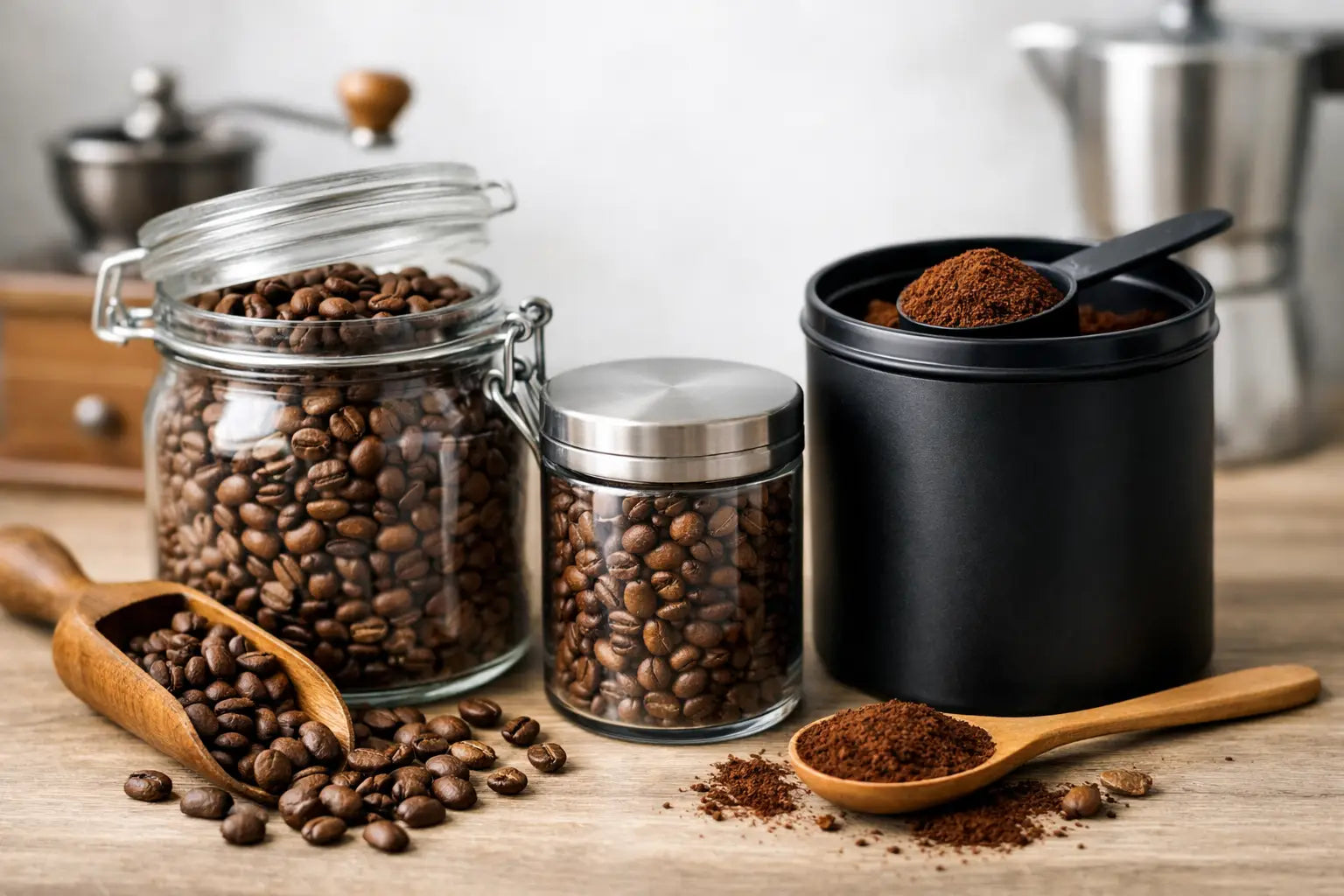
Many people immediately transfer coffee to an attractive glass jar. It looks neat on the counter, but is rarely the smartest choice. Glass lets in light and the jar often contains a lot of extra air. Neither helps coffee. A storage container only works well when it blocks light and limits the air volume.
That is why a good coffee canister is better than a decorative jar. Preferably one that seals airtight and limits contact with oxygen. You may not taste the difference after one day, but you will after one or two weeks.
Original bag or storage canister?
If you finish your coffee quickly, within roughly one and a half to two weeks, the original bag is often fine. Press out excess air after use, seal it properly and store it somewhere dark and dry.
If you drink more slowly or buy larger quantities, a quality storage container is often more convenient. Not because it magically preserves freshness, but because opening and closing it properly is easier in practice. Ease of use matters. The best storage method is the one you consistently use every day.
The biggest mistakes when storing coffee
The fridge is probably the most famous mistake. The idea sounds logical: cool is better. With coffee, it is not that simple. In the fridge, coffee is exposed to moisture, temperature changes and odours from other foods. Coffee absorbs smells easily. You do not want your beans to pick up hints of cheese, onion or leftovers.
The freezer is not a standard solution for everyday use either. Freezing can work, but only when done intelligently. I will come back to that. What does not work is taking a bag out of the freezer, opening it and putting it back every day. That creates condensation and extra stress for the beans.
Another classic mistake is storing coffee beside the oven, in sunlight on the counter or above the dishwasher. Heat accelerates ageing. Steam and moisture do not help either. A coffee corner can be practical, but not at the expense of flavour.
Whole beans versus ground coffee
If you genuinely want to preserve flavour, store coffee as whole beans and grind just before brewing. Ground coffee loses aroma much faster because its surface area is much larger. Oxygen gets free access.
That does not mean pre-ground coffee is immediately bad. It is perfectly practical for convenience, especially when used quickly. But if you wonder why an opened bag tastes less lively after a few days, this is often the answer.
Where should you store coffee?
The ideal place is boring — and that is exactly right. Dark, dry and at room temperature. A kitchen cupboard away from a heat source is usually perfect. No direct sunlight, damp air or large temperature swings.
That sounds less exciting than a designer jar on the counter, but flavour wins over styling. If you buy good coffee, you want the final cup to be convincing too.
How much coffee should you buy at once?
It depends on your consumption. For most home drinkers, buy an amount you can finish within two to four weeks after opening. This is often the sweet spot between convenience, freshness and price.
If you prefer to buy in bulk, divide your supply into smaller portions. Open only what you will use soon and keep the rest sealed. This limits how often all your coffee is exposed to air.
That is a practical lesson where many people gain the most. Keep a working supply separate instead of repeatedly opening and closing one large bag. It makes more difference than you might think.
Freezing coffee without flavour loss — only if done properly
The freezer is not a myth, but it is not a miracle either. For longer storage of unopened or properly portioned coffee, freezing can be smart, especially when you buy several bags or want to preserve a limited release.
The condition is to work in portions. Store the coffee airtight, preferably in an amount you will use within a few days. Take a portion out of the freezer and let it reach room temperature before opening it. This prevents condensation on the beans.
For daily opening and closing, the freezer is inconvenient and often counterproductive. For long-term storage of reserve coffee, it can work very well. It is not a simple yes or no; it depends on how you use it.
How to recognise that coffee is losing freshness
You usually notice flavour loss in the cup before you see it in the beans. The aroma becomes flatter, sweetness declines and the finish becomes shorter. With espresso, extraction may also become less predictable. Brew time changes, the crema looks different or the shot suddenly tastes drier.
With filter coffee, clarity often fades. Where you first tasted clear notes, only a more general coffee flavour remains. Not necessarily unpleasant, just less interesting.
That is why freshness makes such a difference. You do not buy specialty coffee for an average cup. You buy it because origin, roast and flavour profile genuinely matter.
What works best at home?
For most coffee drinkers, the best approach is surprisingly simple. Buy whole beans, choose fresh coffee from a roaster that is clear about roast date and freshness, store opened coffee airtight and dark, and grind only what you need.
If you want to go one step further, use a good storage container for your daily supply and keep extra coffee separate in unopened bags or frozen portions. It is practical, consistent and produces noticeably better cups. That is why many enthusiasts choose genuinely fresh beans and a storage system that does more than look good.
A few details that matter more than you think
Always use clean, dry hands or a dry scoop when taking beans from a container. Moisture in your supply is disastrous. Do not leave the packaging open unnecessarily while brewing either. It seems minor, but coffee responds to repetition. Small bad habits add up over time.
Be realistic about your routine. If you drink two cups a day during the week, your ideal supply is different from someone making espresso for the whole family. Storing coffee well is not about rigid rules, but about a system that fits your usage.
Once you set that up properly, you notice the difference quickly — not only in aroma, but especially in the cup. More sweetness, more detail and more calm. That is what storing coffee without flavour loss is ultimately about: making sure coffee roasted with care reaches your cup with the same care.
Good coffee does not require a complicated ritual, only a little respect for freshness.
Updated CoffeeVac advice
Once a bag is open, an airtight CoffeeVac canister gives your freshly roasted beans a more consistent storage routine. Choose a size that matches your supply, close it after every dose and keep it away from heat, light, moisture and strong odours.
The 1 kg model can hold the original opened bag, including its packaging. Fold the opening inwards, close it with a coffee clip and place the bag upright in the canister. The CoffeeVac Pump 250g is the compact alternative when you want to remove extra air manually; it works without batteries or electricity. See the CoffeeVac collection and our complete coffee storage guide.
Share:
Decaf vs Regular Coffee: What Can You Taste?
How to Brew Better Coffee at Home in 7 Steps