
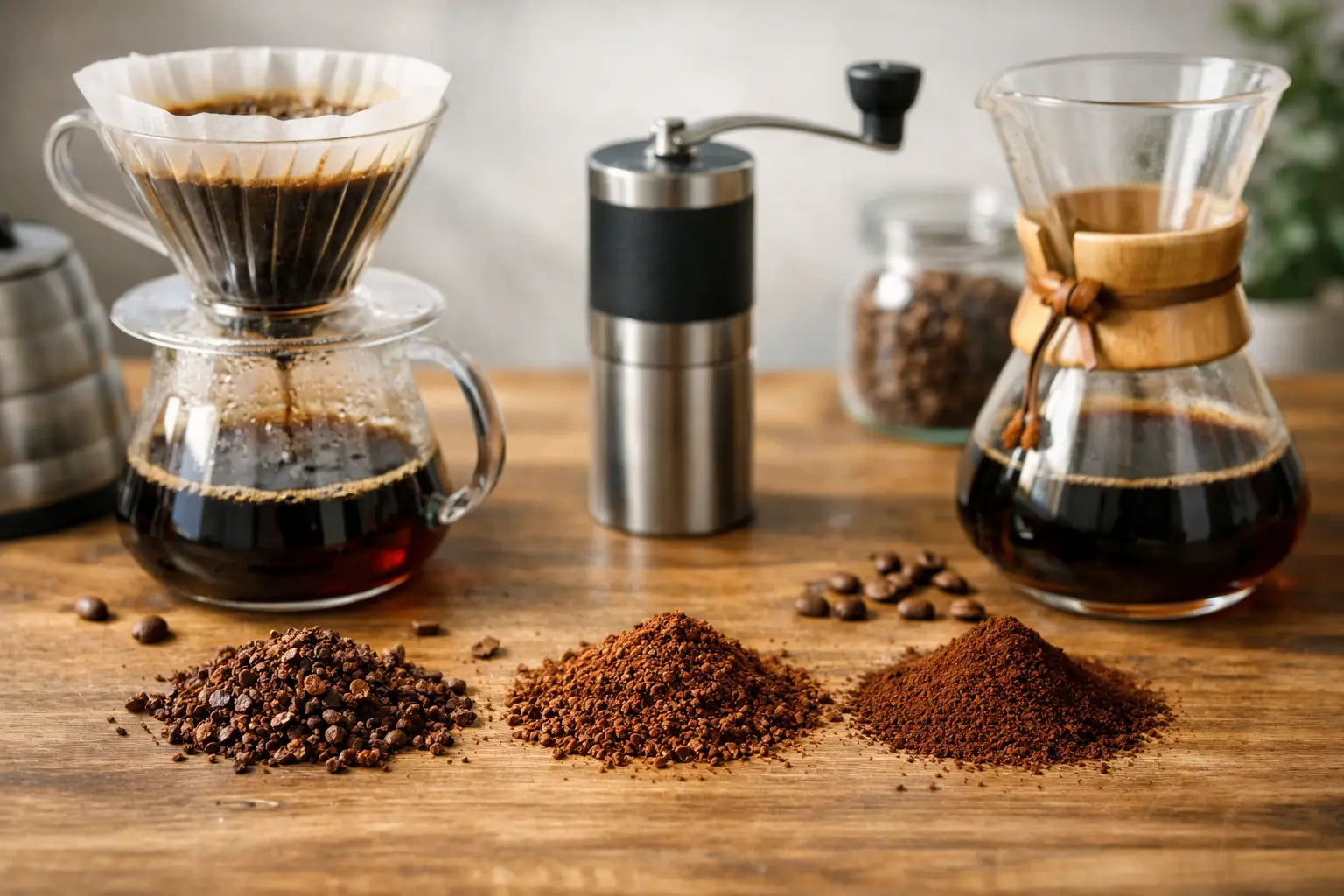
Your coffee beans can be perfectly fresh and well roasted, but the wrong grind will still turn filter coffee into a disappointment. The question of which grind size you need for filter coffee is not a minor detail. It is often the difference between a flat, watery cup and one with sweetness, balance and clear flavour notes.
As a starting point, filter coffee needs a medium to medium-coarse grind. That sounds simple, but in practice it depends on the brewing method, brew time, filter paper and even how fresh your beans are. A V60 usually needs a little finer than a Chemex. An automatic filter machine often works better with a slightly coarser grind than people expect. If your coffee tastes bitter or sour, the problem is not necessarily the bean.
What grind size is usually right for filter coffee?
Think of the texture of coarse sand. Finer than a French press, coarser than espresso. For most filter methods, this is a safe starting point. It will not be perfect for every setup, but it gives you a useful base from which to adjust.
This middle range works because filter coffee is about controlled extraction. Water needs enough contact with the ground coffee to dissolve flavour, but not so much that mainly bitterness comes forward. Grind too fine and the water runs slowly, producing a heavier, bitter or syrupy cup. Grind too coarse and the water rushes through, leaving the coffee thin, sour or empty.
There is no universal answer to which grind size is always right. The right grind is the one that produces a balanced cup with your recipe, grinder and brewing method.
The right grind for each filter method
V60 and other pour-over brewers
For a V60, you are usually in the medium range, sometimes towards the finer end. With small doses, such as one cup, a slightly finer grind can help achieve enough extraction. With larger batches, you can often go a little coarser to prevent clogging and over-extraction.
A V60 reacts quickly to small changes. That is useful, but unforgiving. One click finer or coarser can clearly change flavour and brew time. If you mainly taste fresh acidity without sweetness, grind a little finer. If the coffee becomes dry, bitter or heavy, go a little coarser.
Chemex
For a Chemex, you generally grind coarser than for a V60. This is mainly because of the thicker filter paper and the way the water flows. A grind that is too fine quickly creates a slow, clogged brew with a flat and bitter result.
The Chemex is known for a clean, elegant cup. A medium-coarse grind suits it well. Expect less body than with some other methods, but plenty of clarity. If you want more strength, adjust your coffee-to-water ratio rather than only changing the grind.
Automatic filter machine
Filter machines are often underestimated. With good, genuinely fresh beans and the right grind, they can produce an excellent cup. Most machines work best with a medium to medium-coarse grind.
Many people grind too fine for a filter machine in the hope of getting more flavour. The brew then takes too long or develops a bitter edge. Especially with machines that brew relatively hot, slightly coarser is often better. Judge not only intensity, but also balance.
Kalita Wave and similar drippers
A Kalita Wave usually sits between a V60 and a Chemex. Its flat bottom and smaller outlets make extraction more forgiving. A medium grind is usually a good starting point.
That makes it popular with home baristas who want control without being punished for every pouring movement. If you value consistent results, it is a pleasant middle ground.
How to tell whether you are grinding too fine or too coarse
The flavour almost always tells you what is going wrong. Not perfectly, but surprisingly clearly.
If your filter coffee tastes sour, sharp, grassy or watery, you are probably grinding too coarse. The water has too little time or contact to extract enough sugars and soluble flavours. You get acidity, but little body and sweetness.
If your coffee tastes bitter, astringent, dry or heavy, you are probably grinding too fine. The water extracts too much, including less pleasant bitter compounds. The cup can also taste muddy or flat, as if all its liveliness has disappeared.
Look at brew time too. If a pour-over finishes much faster than your recipe suggests, grinding finer is usually the answer. If it takes unusually long, grind coarser. Taste remains the guide, but time is a useful check.
Your grinder matters more than you think
It is not only grind size that matters, but also how evenly your grinder grinds. A poor blade grinder produces dust and large pieces at the same time. The fine particles over-extract while the coarse particles under-extract. You can keep adjusting your recipe, but the biggest gain may come from a better grinder.
A good burr grinder produces much more consistent particles and therefore more predictable extraction. You notice it directly in the cup: more sweetness, more calm and more control. With filter coffee, where nuance matters so much, this makes a major difference.
Freshness matters too. Very fresh coffee may run differently from beans that have rested longer. Recording one grind setting is useful, but it is not sacred. Small adjustments are part of the process.
Start here when dialling in
Use a fixed ratio, such as 60 grams of coffee per litre of water, and change only one thing at a time. Do not adjust grind, dose and pouring technique simultaneously, because you will learn nothing. Start with a medium grind and taste deliberately.
If the coffee disappoints, make a small adjustment. Really small. One click on your grinder may be enough. Give yourself two or three attempts before drawing conclusions. Filter coffee is precise, but not mysterious. Calm testing gets you there quickly.
Write down what you do if useful: bean, grind, dose, time and flavour. That may sound enthusiastic for a weekday morning cup, but it saves a lot of guesswork later. Once you have found the right range, you only need to adjust occasionally.
A common mistake: judging by appearance instead of behaviour
Many home brewers judge the grind mainly by how it looks. That is understandable, but limited. One grinder’s setting 18 can be completely different from another’s. Even terms such as medium or medium-coarse are directions, not exact science.
More important is how the coffee behaves during brewing and tastes in the cup. Does it flow well? Does it smell sweet and clear? Do you taste balance between freshness, body and finish? If so, your grind is right even if it looks slightly finer or coarser than a photo online.
What if you use pre-ground coffee?
Pre-ground filter coffee can work well, but you almost always sacrifice some control. You cannot adjust the grind to your method, and aroma fades faster after grinding. If you want to understand what makes specialty coffee special, grinding fresh is the step that usually makes the biggest difference.
If you do use pre-ground coffee, choose one explicitly ground for filter and use it as fresh as possible. Store it well sealed and do not keep it unnecessarily long. The better the bean and the fresher the roast, the more you can still taste.
Good filter coffee therefore does not require complicated equipment, but it does require the right adjustment. Treat grind size as a control rather than an afterthought. With fresh beans, a decent grinder and a few small changes, you can quickly reach a cup you genuinely look forward to.
Share:
How to Recognise Real Specialty Coffee
Decaf vs Regular Coffee: What Can You Taste?