
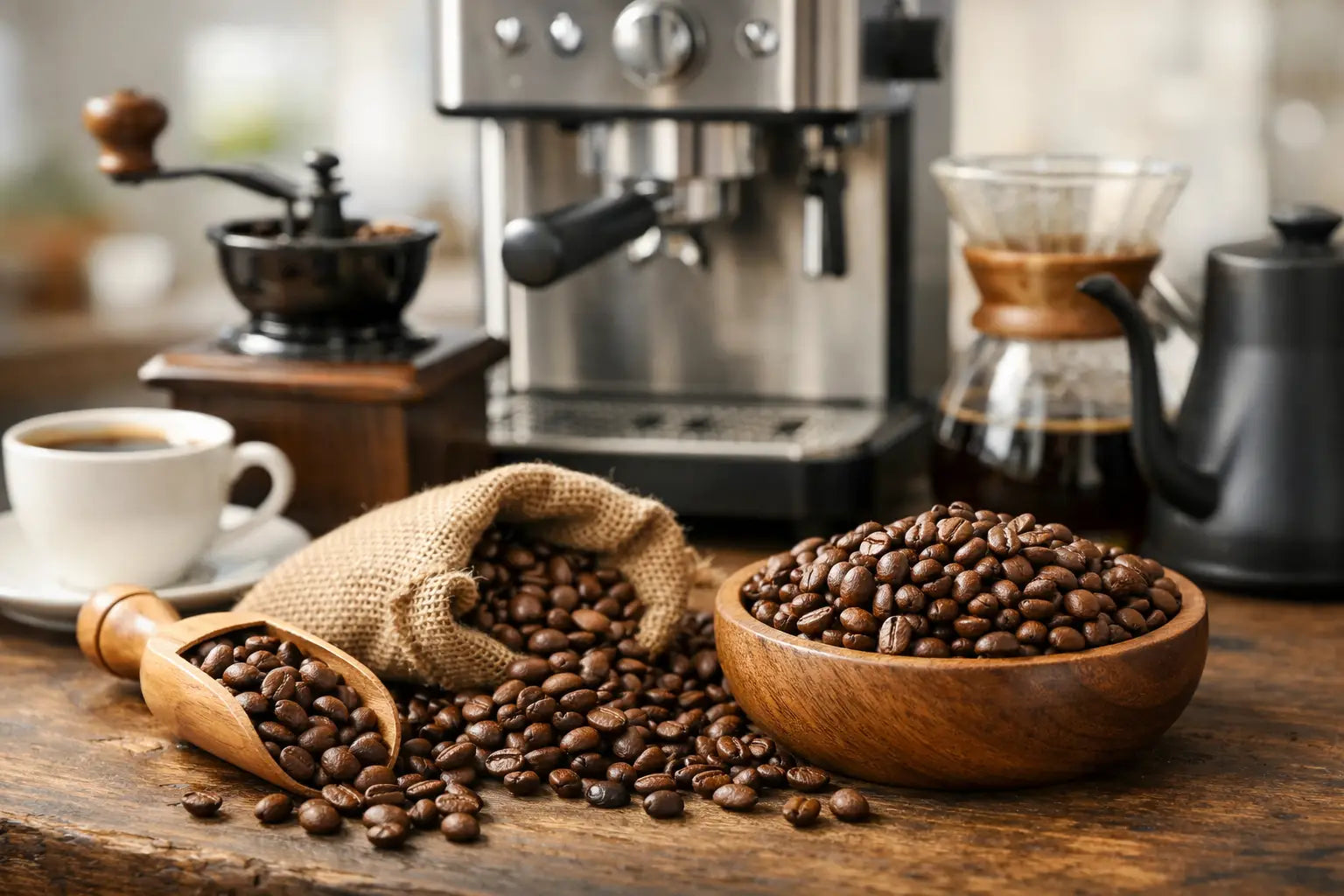
You do not recognise the best coffee beans for home by an elegant bag or a clever word on the front, but by what happens when you grind and brew them. Does the coffee smell lively? Can you clearly taste chocolate, nuts or fruit? Does the cup remain clean and balanced? If so, you are on the right track. Many home drinkers want better coffee but still buy beans that have been sitting too long, roasted too dark or simply do not suit their brewing method.
What are the best coffee beans for home?
It depends less on one universal “best” and more on three things: how you brew, which flavours you enjoy and how fresh the beans are. A superautomatic machine often needs a different roast from a portafilter machine or filter setup. Someone who likes creamy, chocolatey and approachable coffee will usually choose differently from someone looking for fresh, fruity flavours.
The real mistake is thinking that all quality beans automatically work well in every kitchen. It is not that simple. A light specialty roast can be excellent as filter coffee but taste too sharp or light in a superautomatic machine. A very dark espresso roast gives plenty of body but can flatten subtle origin flavours. Good coffee at home starts with an honest match, not the strongest claim.
Freshness is often more important than people think
If you want to taste a real difference at home, freshness is not a detail but the foundation. Coffee beans slowly lose aroma after roasting, and ground coffee deteriorates even faster. That is why whole beans are almost always the better choice at home, provided you can grind them yourself or have a machine that does it.
Do not look only at a best-before date. It tells you surprisingly little. A roast date is much more useful because it tells you how old the coffee really is. For home use, you want beans fresh enough to taste lively but not so extremely fresh that they extract erratically, especially with espresso. The ideal window is often somewhere from a few days of rest to several weeks after roasting, depending on the bean and roast.
That is exactly why many supermarket beans disappoint. They are not necessarily undrinkable, but they have often been on the road too long to remain genuinely exciting. Fresh specialty coffee smells different as soon as you open the bag—richer, more precise and less flat.
The right roast for your machine
For superautomatic machines
Superautomatic machines need forgiving beans. Extremely dark, oily beans can dirty the machine. Very light-roasted beans do not always produce the best result either because extraction is more limited in a superautomatic than in a good portafilter machine.
For most superautomatic machines, medium to medium-dark roasts work best. Think of flavours such as milk chocolate, nuts, caramel and perhaps some red fruit in the background. They provide enough body and sweetness without making the coffee bitter or heavy.
For portafilter machines
A portafilter machine gives you more control, but that also means more responsibility. You can experiment with light to medium espresso roasts as long as your grind, dose and brew time are under control. The best coffee beans for home can be remarkably distinctive in this category: think stone fruit, cocoa, brown sugar or floral notes.
If you drink cappuccinos and flat whites, a little more body is often pleasant. If you mainly drink straight espresso, you can choose something more adventurous.
For filter, V60 and cafetière
Lighter roasts often work beautifully for filter coffee because they show more clarity and origin character. Ethiopian coffee can be floral and citrusy, Colombian coffee rounded and sweet, and Brazilian beans often nutty and comfortable.
With a cafetière or French press, a fuller and rounder profile can be ideal. Beans with chocolate, hazelnut and gentle spice notes often work very well.
Origin tells you something, but not everything
Many home drinkers use country of origin as a guide. That is logical, but it is not a shortcut to a guaranteed flavour. Origin gives direction, not an absolute outcome. Processing, variety and roast have just as much influence on what ends up in your cup.
There are still useful patterns. Brazil is often a safe choice if you enjoy classic, soft coffee with nuts and chocolate. Colombia often sits nicely in the middle: approachable, sweet and balanced. Ethiopia can be lively, fresh and aromatic. Guatemala and Costa Rica often offer plenty of structure and elegance.
If you are moving from supermarket coffee to specialty coffee, it is usually smart to start with an approachable medium roast from Brazil or Colombia. Not because it is automatically better, but because these coffees often show what freshness and quality can do without the profile becoming too extreme.
What should you look for when buying online?
Ordering coffee online is ideal if you do not have time to visit a roaster repeatedly, but you should remain critical. Start with transparency. Is a roast date listed? Is the flavour profile, origin and roast explained clearly? If so, there is a greater chance you are buying from a company that takes coffee seriously.
Read flavour descriptions with a level head too. “Chocolate, caramel, red fruit” is useful. “Unique flavour explosion” tells you little. Good suppliers help you choose based on brewing method and taste, not only marketing language.
Also look for freshness as a concrete promise, not just a concept. Seriously fresh coffee sounds good, but it should be supported by how and when the coffee is roasted and shipped. That makes a real difference at home.
Common mistakes with coffee beans for home
One of the biggest mistakes is focusing too much on intensity. Many packages show a strength indicator, but it says far less about quality or flavour than people think. A “strong” coffee can simply be dark and bitter without any real depth.
A second mistake is poor storage. Beans in an open bag next to a hot oven lose quality quickly. Light, air, heat and moisture all threaten flavour. Store coffee in a cool, dark and well-sealed place. Not in the fridge, where moisture problems and odour transfer are more likely.
The third mistake is buying too much at once without a plan. Buying in bulk can be convenient, but only if you know you will store and finish the beans within a reasonable time. For many households, a supply for a few weeks is smarter than a huge bag that slowly loses its character.
Choose the best coffee beans for home by flavour
If you do not know where to start, choose based on the drinking experience rather than technical details. Do you like soft, rounded coffee without sharp edges? Nutty and chocolatey beans will probably suit you. Looking for more energy in the cup? Fruitier or more floral coffees may be more interesting.
If you usually drink black coffee, you notice nuance more quickly and can choose something lighter or more expressive. If you often add milk, you want enough body and sweetness in the base. That usually means an espresso roast that can hold its own in a cappuccino or latte.
The great thing is that experimenting at home teaches you a lot. One coffee that fits your machine exactly is more valuable than five bags that are only “maybe” right. Eddy’s Coffee follows the same approach: no unnecessary complexity, just fresh specialty beans that should work at home.
How to get more from good beans
Good beans deserve decent preparation. It does not have to become obsessive. A few basic choices already make a big difference. Grind fresh when possible. Use water without an odd taste. Adjust your grind if the coffee runs too quickly, too slowly, tastes too sour or too bitter.
With espresso, grind coarser when the flow is too slow and finer when it runs too quickly. For filter coffee, fine-tune calmly rather than changing everything at once. Once you understand this, you quickly notice the bean itself coming through more clearly.
That is also the charm of home coffee. You do not have to be a barista to drink better coffee than in many cafés. With fresh beans, a suitable roast and a little attention, you can get surprisingly far.
The best coffee beans for home are therefore not necessarily the most expensive, darkest or most exclusive. They are the beans that are fresh, honestly roasted and well matched to your machine and taste. Once you find that combination, your daily cup becomes something to look forward to rather than something you simply get through.
Share:
12 Coffee Gift Ideas for Coffee Lovers
How to Choose Coffee Beans for Working from Home