
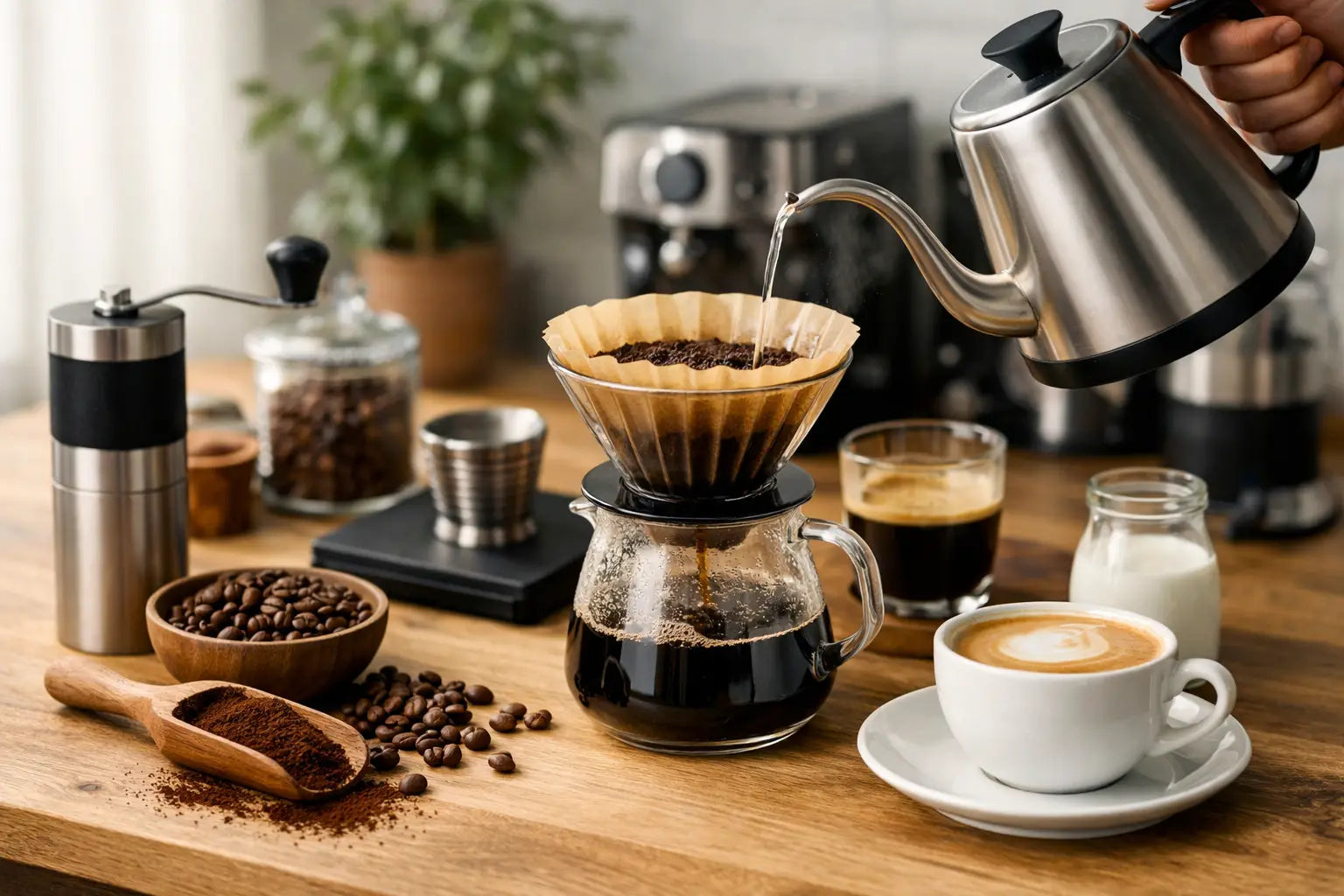
Most home-brewed coffee does not go wrong because an expensive machine is missing. It goes wrong for simpler reasons: old beans, the wrong grind or guessing at water and ratios. If you take better coffee at home seriously, you do not need to build a barista setup on the counter. You mainly need more control.
Good coffee at home is not a mystery or an elite sport. It is the sum of fresh coffee, a suitable grind, clean water and a brewing method that is properly adjusted. Once the basics are right, you taste more sweetness, balance and much less bitterness. That is the difference between a mug you drink absent-mindedly and a cup you actually sit down for.
Brewing better coffee at home starts with the bean
If the coffee itself is average, technique can only rescue so much. The bean determines the starting point. Coffee that has spent too long in a warehouse or supermarket loses liveliness. Aroma fades quickly, especially when beans are old or stored badly.
Choose freshly roasted specialty coffee beans. Not because it sounds luxurious, but because you can taste it. Specialty coffee tastes cleaner, has more nuance and shows what the bean naturally has to offer. Depending on origin and roast, think chocolate, nuts or red fruit. With dark and old coffee, much of that becomes bitterness.
The roast date matters more than marketing language. Coffee does not have to go into your grinder on the same day it is roasted, but genuinely fresh beans that are a few days to a few weeks old usually give the best home results.
Grind size matters more than the machine
Many people overestimate their machine and underestimate the grind. Yet grind size is one of the fastest ways to improve coffee at home. If it is too fine, extraction runs slowly and the coffee often tastes bitter or harsh. If it is too coarse, the cup tastes flat, sour or watery.
The right grind depends on your method. Espresso needs a fine grind, filter coffee a medium grind and a French press a coarse grind. There is nuance, because every bean behaves differently. A light Ethiopian roast may need a different setting from a fuller Brazilian roast.
Pre-ground coffee is convenient, but less flexible. Once coffee is ground, flavour disappears faster. If you want a real step up, buy a good coffee grinder. It does not have to be exotic, but it should grind consistently. Uneven particles create a messy result: some over-extract while others remain under-extracted.
Water is not a minor detail
Coffee is roughly 98% water. It is strange how often this is ignored. Very hard water suppresses flavour and can burden your machine with limescale. Very soft water can make coffee taste flat or empty.
In practice, clean, fresh water without a strong smell or taste gets you a long way. If your tap water is very hard, filtered water often helps immediately. Not magically, but noticeably. With filter coffee and pour-over, the difference is often clearer than people expect.
Temperature matters too. Boiling water is usually too hot. Aim for roughly 92 to 96°C. If you cannot control temperature, let the water rest for 30 to 45 seconds after boiling. This prevents the coffee from tasting burnt and pulling mainly bitterness from the grounds.
Stop guessing your ratio
A scoop here and a little extra there rarely produces consistent coffee. If you want better coffee at home, stop relying on guesswork. A scale makes a bigger difference than a shiny hundred-euro accessory.
For filter coffee, a good starting ratio is 60 grams of coffee per litre of water. For a 300 ml mug, that is around 18 grams of coffee. Adjust from there. For more body, use a little more; if it tastes too heavy, reduce the dose by a gram or two.
Espresso works differently, with dose, extraction time and yield. But the same principle applies: measuring beats guessing. Once you know what goes in and comes out, you can improve deliberately.
Adjust your brewing method properly
Every brewing method produces a different cup, and that is fine. A French press gives more body and oil. A V60 or other dripper reveals more clarity and nuance. An automatic machine is convenient and fast, but needs attention to settings and cleaning.
Filter coffee and pour-over
Filter brewing is all about consistency. Rinse the filter paper first to prevent paper taste and warm the dripper or jug at the same time. Pour in stages rather than all at once. Start with a bloom of about 30 seconds so carbon dioxide can escape from fresh coffee. Then continue pouring calmly and evenly.
If the water runs through too quickly, grind a little finer. If it takes too long, grind coarser. You do not need a major correction; small steps often work best at home.
French press
Patience is your friend with a French press. Use a coarse grind and steep for about four minutes. Stir briefly, skim foam if you like and press down slowly. Too fine a grind quickly gives muddy bitterness. Leaving the coffee standing too long does not improve it either.
Automatic machine and espresso
An automatic machine is strongest when convenience matters. But convenience without maintenance costs flavour. Clean the brew group, lines and milk system consistently. Do not set the grind too fine if the machine cannot handle it stably. Many home users chase intensity and end up with harsh coffee.
Freshness is particularly critical for espresso. Beans that are too old produce little crema and dull flavour. Beans that are extremely fresh may extract unevenly. The sweet spot is often a few days after roasting, although tasting remains the guide.
Storage makes the difference on day ten
You can buy perfect beans and slowly kill them in a half-open bag beside the oven. A shame. Light, air, heat and moisture are the enemies of flavour. Store coffee airtight, dark and at room temperature.
The fridge is usually a bad idea. Temperature changes and moisture work against you. Freezing can work, but only when portions are well sealed and not repeatedly thawed. For daily use, a good storage canister with a proper seal is often the smartest choice.
Do not automatically buy a large amount when your consumption is low. Freshness only helps when you drink the coffee in time. A smaller order that moves through your grinder quickly often tastes better than a kilo bag left open for weeks.
Why your coffee may still not taste right
Even with fresh beans and a careful process, coffee can disappoint. Often one variable is slightly wrong. If coffee tastes sour and thin, extraction is usually too low. Grind a little finer, extend contact time or use a little more coffee. If it tastes bitter and dry, go the other way: grind coarser, shorten extraction or lower the temperature slightly.
Cleaning is also underestimated. Old coffee residue and oil build up quickly in grinders, portafilters and machines. This creates a rancid aftertaste that better beans cannot fix. Cleaning is part of good brewing, not an afterthought.
If you want consistently better coffee, change only one thing at a time. Otherwise you will not know why a cup improved or worsened. It may sound obsessive, but it prevents frustration and teaches you what your bean, machine and taste need.
Brewing better coffee at home without unnecessary fuss
You do not need a barista course to drink much better coffee at home. Start with three things: fresh beans, the right grind and a fixed ratio. Then look at water, storage and the settings for your brewing method. It is not a spectacular route, but it works.
For many coffee drinkers, this is the turning point. Instead of hoping that an expensive machine will solve everything, you understand where flavour really comes from. That makes home coffee more logical rather than more complicated. Once you find a freshly roasted bean that suits your method, you realise how little is needed for a cup that simply works.
A good cup of coffee at home ultimately feels less like luxury and more like a smart everyday standard.
Share:
How to Store Coffee Without Losing Flavour
Guide to Choosing Specialty Coffee Beans