
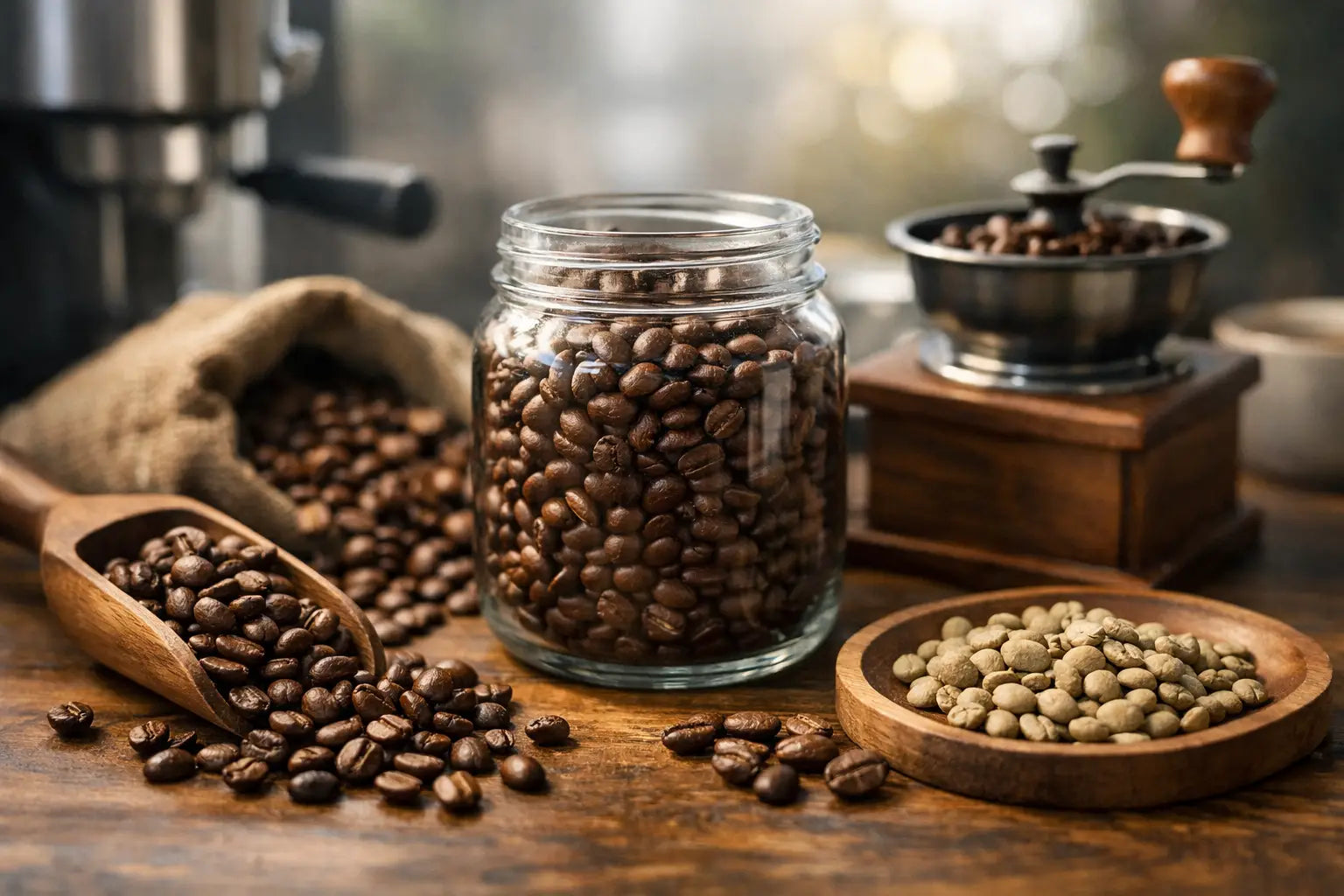
A coffee bean roasted this morning is not automatically at its best by this evening. So when are coffee beans fresh? The honest answer is: from the roast date onwards, but often only after a short resting period are they truly ready to brew. If you only look at the best-before date, you miss the point at which flavour, aroma and a balanced extraction really begin.
You can recognise fresh coffee not by a marketing term, but by a clear roast date, proper packaging and a flavour that stays lively in the cup. It sounds simple, but timing makes a real difference—especially if you brew espresso at home or want to get the most out of specialty coffee.
When are coffee beans fresh enough?
Coffee beans are fresh as soon as they have been roasted. During roasting, the green bean changes into the aromatic coffee bean you know. Thousands of flavour compounds are created, along with carbon dioxide. That gas needs time to escape from the bean. This process is called degassing.
Degassing is particularly intense during the first few days after roasting. The aroma can be fantastic, but the coffee may still be difficult to brew consistently. With espresso, you may notice a fast and erratic flow, lots of bubbles and a flavour that comes across as sharp, flat or messy. The bean is fresh, but it has not fully settled yet.
For most coffees, a practical guideline is to let the beans rest for around five to ten days after the roast date before judging them at their best. Filter coffee can sometimes be ready a little earlier. For espresso, a resting period of seven to fourteen days is often a good starting point. The ideal window depends on the roast, origin, brewing method and even your grinder.
Lighter roasts generally need more time to stabilise. They are often denser and release gas more slowly. Darker roasts may become easier to brew sooner, but they also tend to lose their peak quality more quickly. There is no magic day on which every coffee becomes perfect.
The roast date tells you more than the best-before date
A best-before date mainly tells you how long a product remains safe and suitable for sale. For coffee, it says little about the period when it tastes best. A bag of beans with nine months left before its best-before date may have been roasted months ago. It may still be perfectly drinkable, but its lively aroma, sweetness and complexity have probably declined considerably.
The roast date is the date you really want to know. It allows you to understand where your coffee is in its flavour development. If you buy beans roasted a few days ago, give them some time to rest at home. If you buy beans that are three weeks old, you can usually start brewing straight away. That is exactly why freshly roasted coffee makes such a difference: you know what you are buying and can control your brewing window.
At Eddy's Coffee, beans are roasted to order. That does not necessarily mean you have to wait before opening the bag. It does mean you know what to expect: freshly roasted coffee with a roast date that lets you brew with confidence.
The best flavour window in practice
For many home coffee drinkers, the peak period for coffee beans is roughly between one and six weeks after roasting. During this time, most aromas are still clearly present and degassing has progressed enough for a predictable brew.
If you brew espresso, feel free to start experimenting from day seven. Is the coffee still difficult to dial in, do you taste a lot of sharpness, or does the shot run noticeably fast? Wait another two or three days. A small change in resting time can do more than endlessly adjusting your grind.
If you use a filter method such as V60, Chemex or a cafetière, the coffee can often taste great after just a few days. Even then, taste with intention. A fruity, lightly roasted coffee can develop especially well during its second week. The acidity becomes rounder, the sweetness comes through more clearly and the cup becomes more balanced.
How to recognise beans that are past their best
Older beans are not automatically bad. They are simply less likely to deliver the full, layered cup of coffee you buy specialty beans for. The decline happens gradually, so many people only notice it when they try a genuinely fresh bag.
Look for these signs if you are unsure about your beans:
- The aroma from the bag is weak, dusty or cardboard-like instead of sweet and expressive.
- Your espresso produces very little crema, even though the grind, dose and machine are properly set up.
- The flavour is flat, dry or bitter, without clear sweetness or aroma.
- You have to grind increasingly finer to achieve the same brew time.
That last point is particularly useful for espresso drinkers. As beans age, more gas escapes and the resistance during extraction changes. The grinder setting that was perfect last month may suddenly be too coarse. A small adjustment can help, but it cannot make an old bean fresh again.
Keep coffee fresh: air is the biggest flavour thief
Buying beans with the right roast date is step one. After that, your storage method determines how long that quality lasts. Oxygen, heat, light and moisture are coffee's four main enemies. Oxygen is especially effective at making aromas fade.
Store your beans in a well-sealed, dark package or an airtight coffee canister. Do not leave them in your machine's hopper for long periods. The hopper is often exposed to heat and light, and the beans are repeatedly exposed to fresh air. Instead, add only enough beans for a few days and keep the rest sealed.
Do you buy larger bags because they are convenient or more economical? Divide the contents into smaller portions straight away. Open one portion at a time and keep the others airtight, cool and dark. This prevents your entire supply from being exposed to oxygen for weeks.
Refrigerator or freezer?
The refrigerator is usually not a good idea. Coffee is exposed to moisture and the aromas of other foods. Coffee absorbs smells easily, and nobody wants beans with a subtle hint of old cheese or curry.
The freezer can work if you want to store coffee for a longer period. Only freeze beans in small, completely airtight portions. Take out one portion and let it reach room temperature while still sealed before opening it. Repeatedly thawing and refreezing the same bag is not a smart approach: it creates condensation and reduces quality.
For most households, freezing is not necessary. Order an amount you can drink within three to six weeks instead. This combines convenience with consistent freshness, without complicated storage experiments.
Grind just before brewing
A whole coffee bean naturally protects its own aroma. As soon as you grind it, you dramatically increase its surface area. Oxygen can then do its work much faster. Ground coffee therefore loses its aroma and flavour much more quickly than whole beans.
Only grind what you need for your next cup or brew. Even a difference of a few minutes can be noticeable, especially with espresso and bright filter coffees. Do you not have a grinder yet? A good coffee grinder is often a more worthwhile first upgrade than a more expensive coffee machine. You will taste the difference immediately in the aroma, sweetness and control.
If you need to buy pre-ground coffee, buy it in small quantities and store it particularly carefully in a sealed container. Just do not expect the same liveliness as coffee ground immediately before brewing. That is not an elitist detail—it is simply coffee science.
How much coffee should you buy?
First work out how much coffee you actually drink. A double espresso often uses 18 grams of coffee. With 250 grams of beans, you can therefore make around thirteen to fourteen double espressos. If you drink two cups every working day, a 250-gram bag will be gone sooner than you think.
For a household that drinks coffee every day, a larger bag often makes sense, as long as you divide it properly and use it within a few weeks. Do you only drink coffee at weekends or like switching between different coffees? Choose smaller bags instead. This prevents you from finishing the bag simply because it is there, after the beans have already passed their best.
Freshness is ultimately not about drinking coffee as young as possible, but about drinking it within the right window. Check the roast date, let the beans rest, grind just before brewing and store your supply wisely. That gives every bag the chance to taste as the roaster intended: clear, sweet, full-bodied and anything but flat.
Share:
Coffee Canister vs Original Packaging: Which Keeps Beans Fresher?
What Exactly Is Specialty Coffee? How to Recognise Quality