
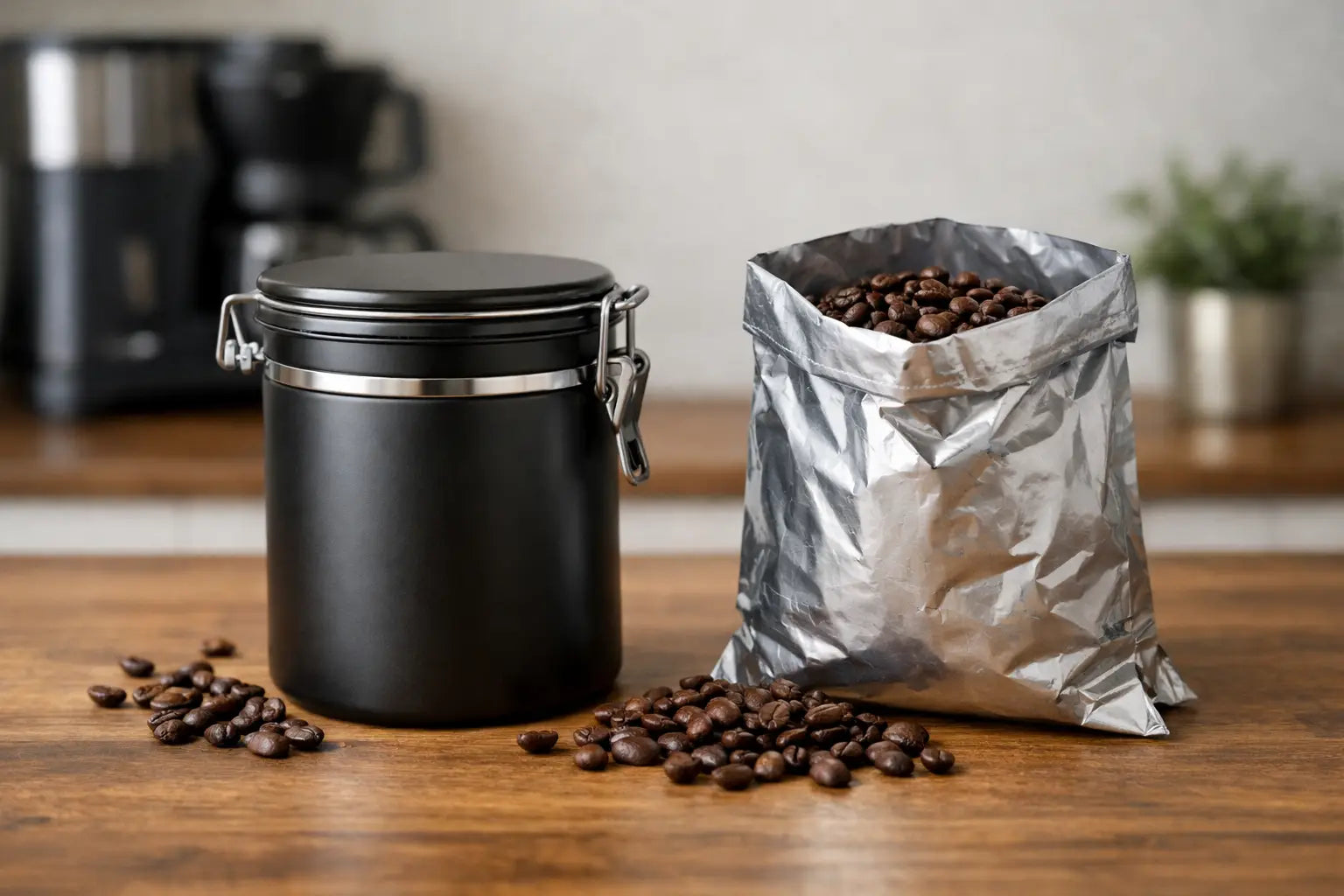
Opening a bag of exceptionally fresh coffee beans smells fantastic. But from that moment, the clock starts ticking too. The choice between a coffee canister and the original packaging is not about what looks best on your counter. It comes down to one question: how do you keep aroma, sweetness and body in your cup for as long as possible?
The honest answer is that good original packaging is often better than many people think. A good coffee canister can then be a clear step forward, provided you use it correctly. The details make the difference.
Why coffee gradually loses quality after opening
Coffee beans contain volatile aromas and oils that create that full fragrance and lively flavour. Oxygen, light, heat and moisture are not exactly friendly to them. As soon as beans come into contact with these elements, oxidation begins. The coffee becomes flatter, less sweet and may eventually taste slightly stale or like cardboard.
Freshly roasted coffee also releases carbon dioxide. That is normal and even a sign that you are working with fresh beans. This is why quality coffee bags often have a degassing valve. The valve lets gas escape without allowing oxygen to enter easily.
The best storage place is therefore dark, dry and at room temperature. Not next to the oven, not on the windowsill and not in the fridge. The fridge in particular is a persistent mistake: temperature changes and condensation can make moisture a problem.
Coffee canister vs original packaging: which protects better?
Original packaging has one major advantage: it is made for coffee. A decent bag is multi-layered, lightproof and fitted with a valve. While unopened, it offers excellent protection. Even after opening, it works well if you press out as much air as possible and close it carefully.
A coffee canister wins mainly when it really seals airtight, is opaque and is not constantly opened for a few individual beans. A canister with a standard lid that does not seal properly is not an upgrade. It may look sleek, but it introduces fresh oxygen to the beans every time. That does not improve them.
A quality vacuum canister or storage container limits exposure to air much better. This is especially useful if you drink coffee every day and your bag stays open for a few weeks. Think of a CoffeeVac: by removing air from the canister and keeping the beans in the dark, you give flavour loss less opportunity.
Still, a canister is not automatically the winner. If you fill a large canister with a kilo of beans but drink only two espressos a week, you keep opening the same supply. In that case, smaller portions are better. Storage is not only about the type of packaging, but also about how much coffee you expose to air at a time.
When the original bag is the smartest choice
If you usually finish a 250-gram bag within two or three weeks, the original packaging is often more than sufficient. Especially if it has a good resealable closure and a valve. Press out excess air after each use, close the bag carefully and store it in a dark kitchen cupboard.
This is also the most convenient option if you drink different coffees side by side. A fruity Ethiopian, a full-bodied Brazilian and perhaps decaf for the evening: keep each coffee in its own packaging. This avoids confusion with labels, leftovers and mixed beans.
The bag is also ideal for unopened supplies. Ordering several bags? Leave the bags that are still sealed closed. Open a new pack only when the previous one is nearly empty. This is smarter than immediately transferring every bean to canisters, however organised that may feel.
When a coffee canister really makes a difference
A coffee canister is a strong choice if you brew the same beans every day and use an opened bag over a longer period. An opaque, well-sealing canister is also valuable extra protection if your kitchen gets a lot of daylight or you have to store coffee on the counter.
Pay attention to capacity. A canister that exactly matches your usual bag is practical, but a slightly smaller canister may be better if you want to store fewer beans at once. The less empty space above the coffee, the less air there is in the canister.
Have you bought a larger supply? Divide it immediately into smaller, clean and dry portions. Use one canister for your daily supply and leave the rest unopened in the original bags, or seal each portion properly. This prevents your entire supply from breathing in air every morning.
How to use a coffee canister without losing flavour
A canister only works well when it is clean and dry. Old coffee oils can stick to the inside and eventually give off a rancid flavour. Clean the canister regularly with warm water and mild washing-up liquid. Then let it dry completely before adding new beans. A few drops of moisture are enough to cause problems.
Do not blindly pour a new bag on top of the last remnants of the previous one either. Empty and clean the canister first, then fill it with fresh beans. Especially when changing roast or origin, you do not want to mix flavours unnecessarily.
Also grind just before brewing. The best coffee canister in the world cannot compensate for pre-ground coffee that sits in contact with oxygen for days. Storing whole beans and grinding fresh remains the biggest flavour gain you can make at home.
Common coffee-storage mistakes
The biggest mistake is putting beans in a glass jar on the counter. Glass lets light through, and light speeds up flavour loss. A jar with a clasp lid is not necessarily airtight enough for coffee either.
A second mistake is storing beans in the fridge or freezer while scooping from them every day. Repeated opening and closing creates temperature changes and possible condensation. Do you want to store coffee for an exceptionally long time, such as a large supply you will not touch for months? Freezing requires careful airtight packaging in small portions. For your daily coffee supply, a dark cupboard at a stable room temperature is simpler and better.
Buying too much can also work against you. A discount price is only economical if you drink the beans while they still taste good. For most households, a supply you finish within four to six weeks is a comfortable starting point. When coffee is freshly roasted, you want to enjoy the window in which the bean is at its best.
Choose based on your coffee routine
If you get through a bag quickly, you do not need to make things complicated. Store the beans in the original bag, press out the air, close it properly and keep it somewhere dark. This is practical, affordable and more than good enough for many coffee drinkers.
If you drink more slowly, have a bright kitchen or want maximum control over your daily supply, choose an opaque, well-sealing coffee canister. Use it for a limited amount of beans and keep the rest protected in the original packaging.
Ultimately, the best choice is not necessarily the canister or the bag, but the method that suits your pace. It is better to open a fresh, smaller supply a little more often than to spend weeks trying to keep an oversized supply artificially young. Your espresso, cappuccino or filter coffee will tell you the difference immediately.
The practical choice after opening a bag
The original coffee bag is useful for transport and for keeping the roast date, origin and flavour information with the beans. The 1kg CoffeeVac is not a reason to discard that bag: place the opened bag upright inside the canister, fold the opening inwards, close it with a coffee clip and close the CoffeeVac. This keeps the packaging and its information intact while reducing unnecessary exposure to air.
For smaller amounts, choose a 250g, 460g, 500g or 880g canister based on the quantity you keep open. The standard models are available in black and mocca; mocca is a colour variant only. The CoffeeVac collection and our coffee storage guide explain the sizes and routine in more detail.
Share:
Online Coffee vs Supermarket Coffee: What Can You Really Taste?
When Are Coffee Beans Fresh? Everything You Need to Know