
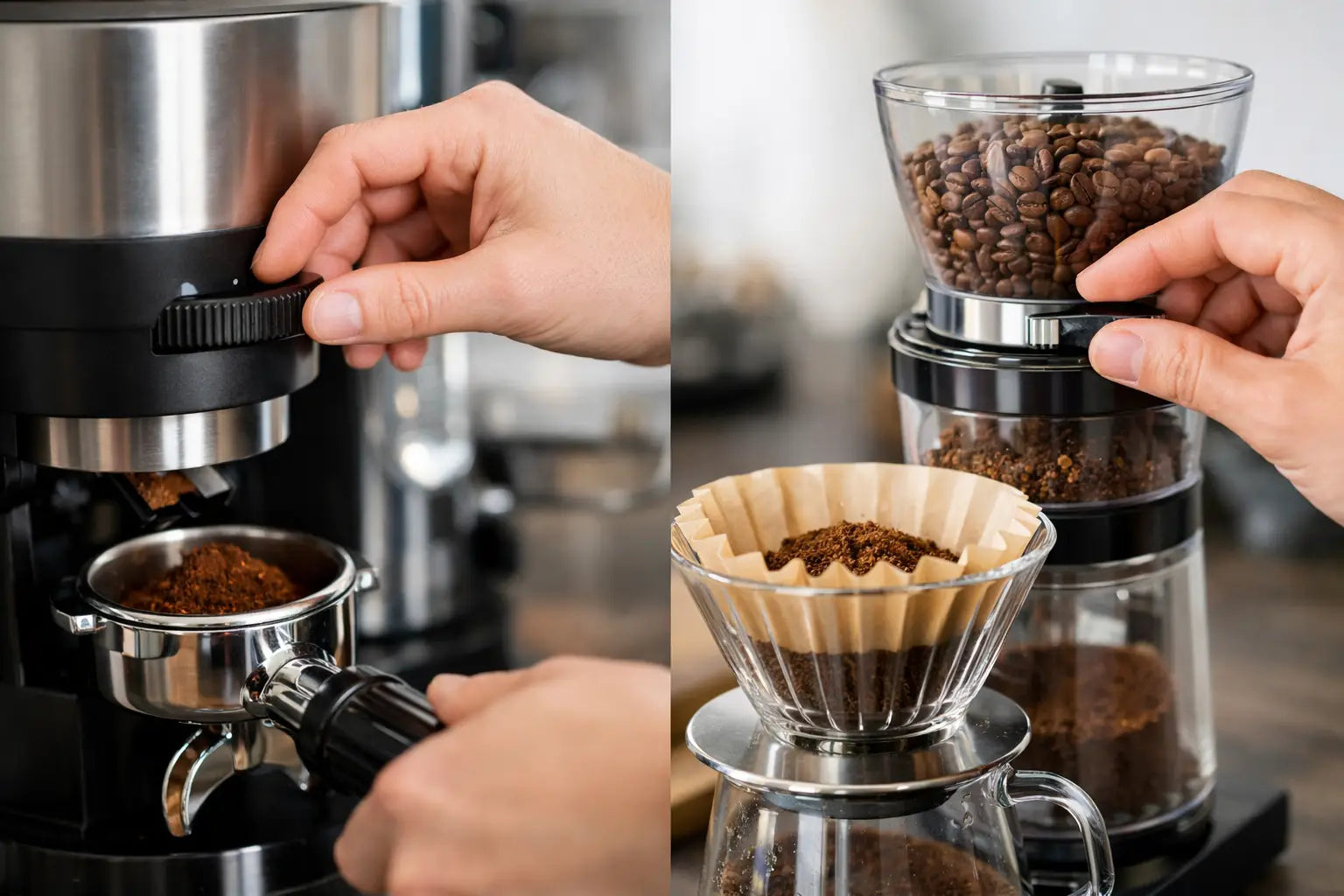
An espresso that shoots through sour, a filter coffee that stays watery or a French press with a bitter finish: the problem is often not the beans, but the grind. Adjusting grind size for each brewing method is the fastest way to make noticeably better coffee at home. With genuinely fresh specialty beans and a few targeted changes, you can taste much more clearly what is in your coffee.
Why grind size makes such a difference
Ground coffee releases flavour as soon as water touches it. The finer the grind, the larger the contact area and the faster water can extract flavour. With a coarse grind, this happens more slowly. The right setting always depends on your method, contact time, water temperature and how quickly water passes through the coffee.
Too coarse is often under-extracted. The cup tastes thin, sour, sharp or slightly salty. Too fine extracts too much, producing dryness, bitterness and heaviness. In espresso, too fine can nearly block the machine; in filter coffee, water may run painfully slowly.
The best grind size is not one magic number on your grinder. It is the setting at which your coffee, water and equipment produce a balanced cup. Treat recommendations as a starting point, not an unchangeable rule.
Adjusting grind size for each brewing method
Espresso: fine, but not suffocating
Espresso needs a fine grind, somewhere between icing sugar and fine sand. Water is in contact with the coffee briefly and is pressed through a compact puck. The grind must therefore offer enough resistance while releasing flavour quickly.
A good basis for a double espresso is 18 grams in and around 36 grams out in 25 to 30 seconds. Does it run through in 15 seconds and taste sour or empty? Grind one step finer. Does it drip for more than 35 seconds and taste bitter or dry? Go a little coarser.
Change only one thing at a time. Keep dose and yield stable, adjust only the grind and taste again. A small click on a good grinder can make a big difference. Remember that freshly roasted beans contain more gas and behave differently from beans that have been open for weeks.
Filter coffee: medium-fine for clarity and balance
For a V60, Kalita Wave or regular filter machine, you usually need a medium-fine grind, similar to table salt. Water flows through the coffee bed in a few minutes and has enough time to carry sweetness, fruit and complexity.
Does the brew finish in less than two minutes and taste weak or sour? Grind finer. Does it take more than four minutes or taste bitter and astringent? Grind coarser. A V60 is sensitive to technique: aggressive pouring, a clogged paper filter or many fine particles can affect brew time. Look at the flavour, not only the clock.
An automatic filter machine often needs a slightly coarser grind than a hand filter because water distribution and brew time differ. Start medium-fine and adjust in small steps.
French press: coarse for a clean, full cup
A French press uses full immersion. Coffee and water usually remain together for four minutes before you press down slowly. Choose a coarse grind, roughly like coarse sea salt.
Too fine and many particles pass through the metal filter. The coffee becomes cloudy, gritty and bitter. Extremely coarse can taste flat. A useful starting point is 60 grams per litre, or 15 grams per 250 ml. If the cup lacks body and sweetness, try a little finer before simply adding more coffee.
Moka pot: finer than filter, coarser than espresso
A moka pot needs nuance. The grind sits between espresso and filter: finer than table salt, but clearly coarser than classic espresso. Steam pressure pushes water upwards, but with much less pressure than an espresso machine. Too fine blocks the flow and quickly creates a harsh, burnt flavour.
Fill the basket loosely to the rim and do not tamp. Use hot water in the lower chamber to keep the coffee from sitting too long on the stove. If coffee comes out very quickly and pale, grind a little finer. If the moka pot sputters aggressively or tastes harsh, go coarser and remove it from the heat sooner.
AeroPress: a wide range, so choose deliberately
The AeroPress is forgiving and therefore fun to experiment with. For a short brew of one to two minutes, medium-fine often works well. With a longer inverted brew, you can grind coarser. For a concentrated, espresso-like cup, go finer but avoid needing extreme pressure.
The rule remains the same: short contact time generally needs finer coffee; long contact time generally needs coarser coffee. The AeroPress makes clear that recipe and grind always belong together.
How to dial in your grinder intelligently
Start with a sensible recipe for your method and weigh coffee and water. Scooping by feel can work with a fixed routine, but a small scale makes adjustment much faster. You know that a flavour difference comes from the grind rather than accidentally using two extra grams.
Then change only one step at a time. For espresso, that may be a tiny adjustment; for French press or filter, it can be larger. Brew the same coffee again and note what you taste: too sour, bitter, thin, dry, or sweet and round. After two or three brews, you usually know which direction to take.
Look at grind consistency too. A blade grinder chops beans into uneven pieces, creating dust, chunks and everything in between. This produces both under- and over-extraction in one cup. A good burr grinder gives much more control and is often the best upgrade after fresh beans.
Common mistakes when dialling in
Adjusting grind size does not solve every problem. These four points deserve attention too:
- Use fresh beans and store them airtight, dark and dry. Old coffee loses aroma and behaves less predictably.
- Grind just before brewing. Pre-ground coffee loses aroma and flavour quickly, even when the package still seems sealed.
- Watch your water. Water that is too cool can produce sour coffee; water that is too hot makes dark roasts bitter more quickly.
- Clean your grinder and brewer. Built-up residue and oil taste rancid and distort every tasting.
Roast level matters too. A light specialty roast is often denser and may need to be ground a fraction finer than a dark roast. Dark beans are more brittle, dissolve faster and may become bitter sooner at the same setting. When you change coffee, recalibrating the grinder is normal.
Ultimately, trust your taste
Brew times, recipes and grind charts help you start, but your taste decides. An espresso at 28 seconds can be fantastic, while another bean becomes sweet only at 33 seconds. Filter coffee can be lively and fresh as long as it does not feel sharp or empty.
Give yourself a few brews to get to know a new coffee. Start carefully, change calmly and taste with attention. Your grinder then becomes not a complicated machine with dozens of settings, but the tool that helps each fresh bean do what it was roasted to do.
Share:
How to Grind Coffee at Home for Better Flavour
How to Buy and Choose Coffee from Colombia